
Structured Cabling vs. Wireless Networking
A fast internet connection is only part of a good business network. The way devices actually connect to that network can have a major effect on performance, reliability, security, and how easily your office can adapt when the business grows. That is why the choice between structured cabling and wireless networking deserves more thought than simply asking which one is faster.
In this guide, we’ll compare structured cabling vs wireless networking across the areas that matter most to businesses, including reliability, performance, security, installation, flexibility, scalability, and cost. More importantly, we’ll look at where each approach makes sense so you can make a network decision based on how your business actually operates.
There is also no need to treat wired and wireless networks as competing technologies. In many modern workplaces, the most practical solution is to use both. The key is knowing which devices and areas should rely on a physical connection and where wireless access makes more sense.
What Is Structured Cabling?
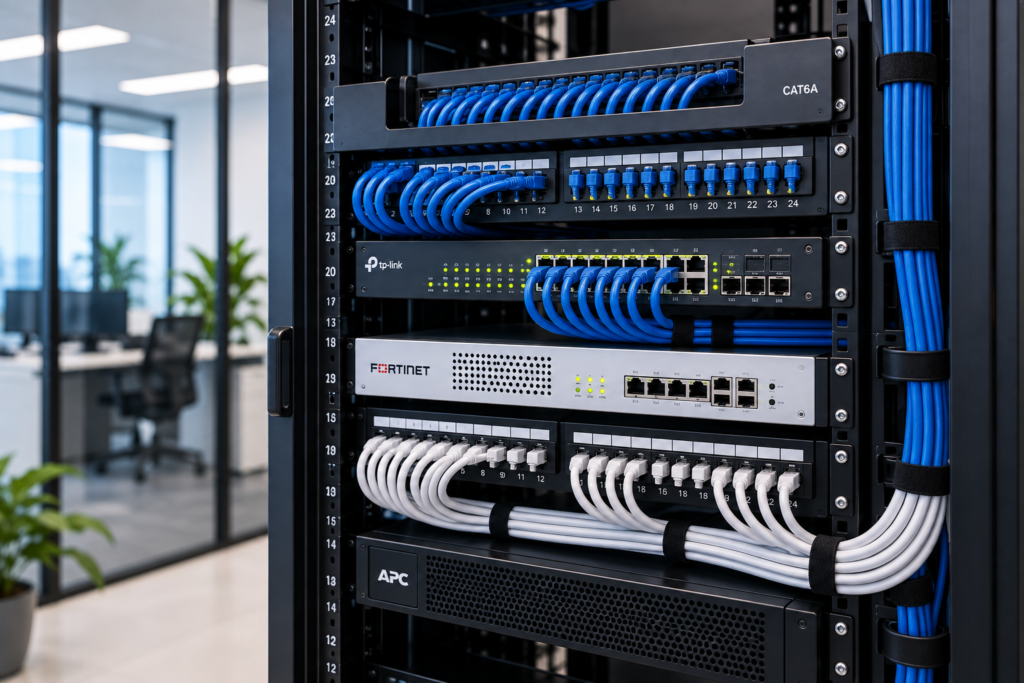
Structured cabling is an organized physical network infrastructure designed to connect devices throughout a building. It typically includes Ethernet cables such as CAT6 or CAT6A, fiber optic cabling, patch panels, network racks, switches, and other supporting components.
Instead of running individual cables wherever they are needed, structured cabling creates a planned infrastructure that can support current requirements and future expansion.
A properly designed structured cabling solution can provide stable connectivity for desktop computers, servers, network switches, IP phones, access points, printers, and other business equipment.
What Is Wireless Networking?
Wireless networking allows devices to connect to a business network through Wi-Fi rather than a physical Ethernet cable. Wireless access points communicate with laptops, smartphones, tablets, printers, IoT devices, and other compatible equipment.
The biggest advantage is obvious: employees can move around without being tied to a network socket.
However, a business Wi-Fi network is not simply a matter of installing a few wireless routers. Coverage, access point placement, interference, network capacity, security, and user density all need to be considered when designing a business network infrastructure.
NIST guidance also emphasizes that wireless network security depends on properly securing and monitoring the components of the WLAN throughout its lifecycle.
Structured Cabling vs Wireless Networking: Key Differences
The easiest way to understand the choice is to compare how each performs in everyday business situations.
| Factor | Structured Cabling | Wireless Networking |
| Reliability | Very high for fixed devices | Depends on coverage and interference |
| Mobility | Limited | Excellent |
| Performance consistency | Generally consistent | Can vary by location and network load |
| Installation | More involved initially | Usually faster to deploy |
| Office flexibility | Requires physical connection points | Highly flexible |
| Security | Physical access is required for connection | Requires strong wireless security |
| Best for | Fixed and critical devices | Mobile and flexible devices |
| Scalability | Planned expansion is straightforward | Additional access points may be required |
Neither option wins in every category. The right choice depends on what your employees and devices need from the network.
Why Businesses Still Rely on Structured Cabling
Reliable and Consistent Performance
One of the biggest advantages of a wired connection is consistency.
A desktop computer connected through Ethernet is not affected by the same wireless interference, signal strength changes, or coverage issues that can affect Wi-Fi. This makes cabling particularly useful for devices that need a dependable connection throughout the working day.
Better for High-Performance Devices
Servers, network equipment, workstations handling large files, and other critical systems can benefit from a direct physical connection.
For businesses transferring large amounts of data or running applications that depend on stable connectivity, wired networking can provide a strong foundation.
Easier to Manage in a Fixed Office
Once properly installed and labeled, a structured cabling system provides an organized physical network infrastructure.
Patch panels, racks, cable management, and testing also make it easier for network administrators to identify connections and troubleshoot physical network problems.
Designed for Long-Term Growth
Good cabling should not be designed only around today’s number of employees.
A growing company may add workstations, meeting rooms, IP phones, access points, printers, or other connected devices. Planning spare capacity from the beginning can prevent unnecessary rewiring later.
Where Wireless Networking Has the Advantage
Employee Mobility
Wireless is particularly useful when employees move between meeting rooms, shared workspaces, reception areas, and other parts of an office.
A laptop user does not need to find an available network port every time they change desks.
Flexible Office Layouts
Businesses frequently change their office layouts. Teams expand, departments move, and collaborative spaces are introduced.
Wireless connectivity makes these changes easier because devices do not need to remain physically connected to a specific wall outlet.
Connecting Mobile and Guest Devices
Smartphones, tablets, visitor devices and many modern business devices are naturally suited to Wi-Fi.
Businesses can also create separate guest networks so visitors can access the internet without receiving unrestricted access to internal business systems.
NIST specifically recommends separating visitor wireless access from the business network as part of secure wireless deployment.

What About Security?
Security is sometimes presented as a simple argument for wired networks, but the reality is more complex.
A physical connection does provide an additional barrier because a device generally needs physical network access. Wireless networks, meanwhile, transmit data over radio signals and therefore require carefully configured authentication, encryption, access controls, and monitoring.
That does not make Wi-Fi inherently unsuitable for business use. A professionally designed wireless network can be secure, but it should be treated as part of the organization’s overall security strategy rather than as an afterthought.
The important point is that both wired and wireless networks need proper network security controls, including appropriate access management, monitoring, and protection for connected devices.
Which Is More Cost-Effective?
There is no universal answer.
Structured cabling can require more planning and installation work at the beginning, particularly in an existing building where cables need to be routed through walls, ceilings, floors, or other difficult areas.
Wireless can reduce some of that physical installation work, but a business-grade Wi-Fi deployment may require multiple access points, controllers or management systems, site surveys, upgrades, and ongoing optimization.
The cheapest installation is therefore not necessarily the cheapest network over its entire lifespan.
For a growing business, it makes more sense to consider:
- Initial installation costs
- Equipment costs
- Future expansion
- Maintenance requirements
- Downtime risks
- Number of connected devices
- Office layout changes
- Performance requirements
When Should a Business Choose Wired Networking?
Structured cabling is usually the stronger choice for devices that stay in one location and require dependable connectivity.
This can include:
- Desktop workstations
- Servers
- Network switches
- Storage systems
- IP phones
- High-performance workstations
- Security and infrastructure equipment
For these devices, mobility is less important than reliability and consistent performance.
When Does Wireless Make More Sense?
Wireless networking is particularly valuable when mobility and flexibility are priorities.
It works well for:
- Laptops and tablets
- Smartphones
- Meeting rooms
- Shared workspaces
- Guest access
- Temporary work areas
- Mobile employees
- Flexible office environments
A well-designed wireless network can make the workplace much easier to use without sacrificing the level of control businesses need.
Why a Hybrid Network Is Often the Best Choice
For many businesses, the real answer to structured cabling vs wireless networking is not choosing one and ignoring the other.
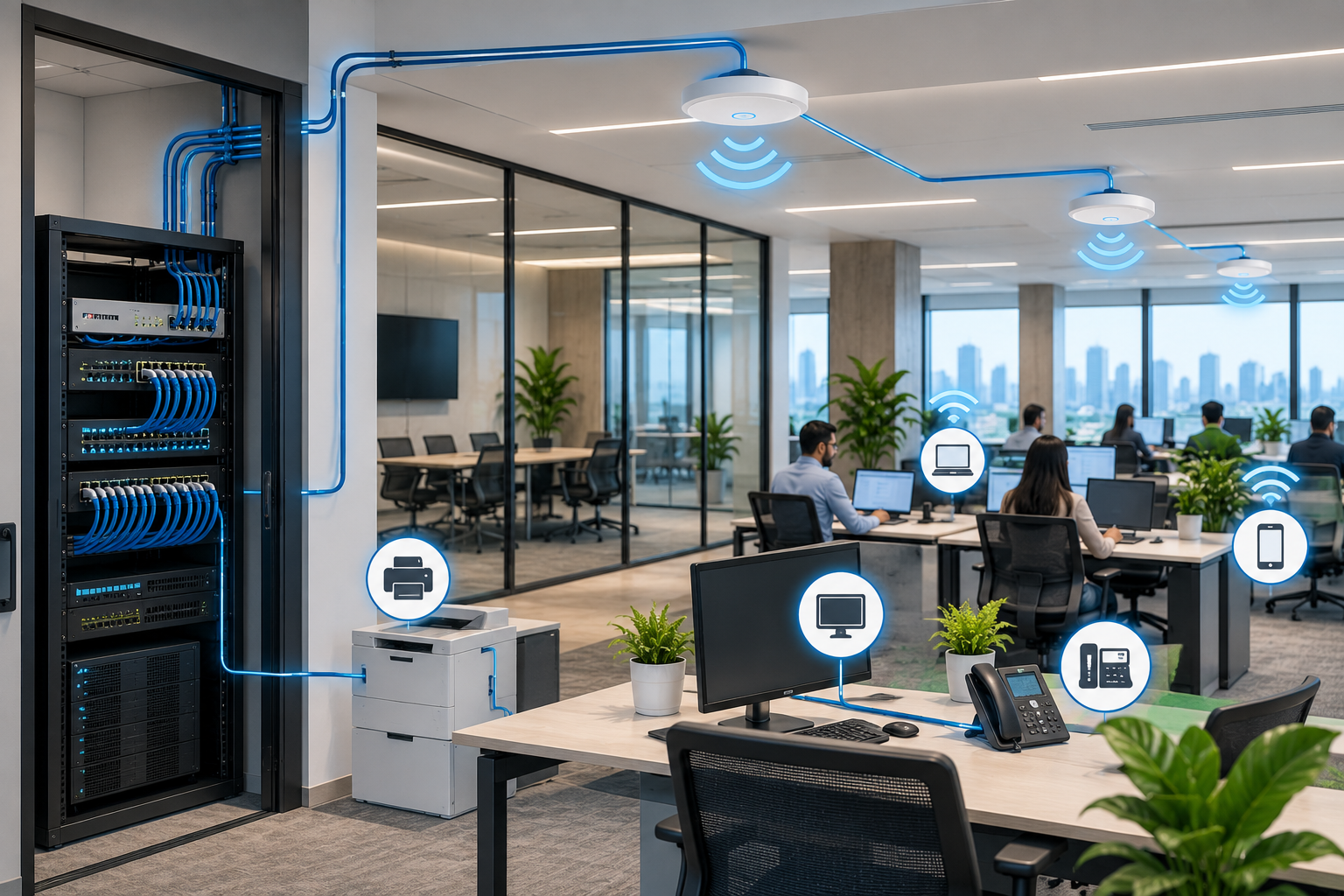
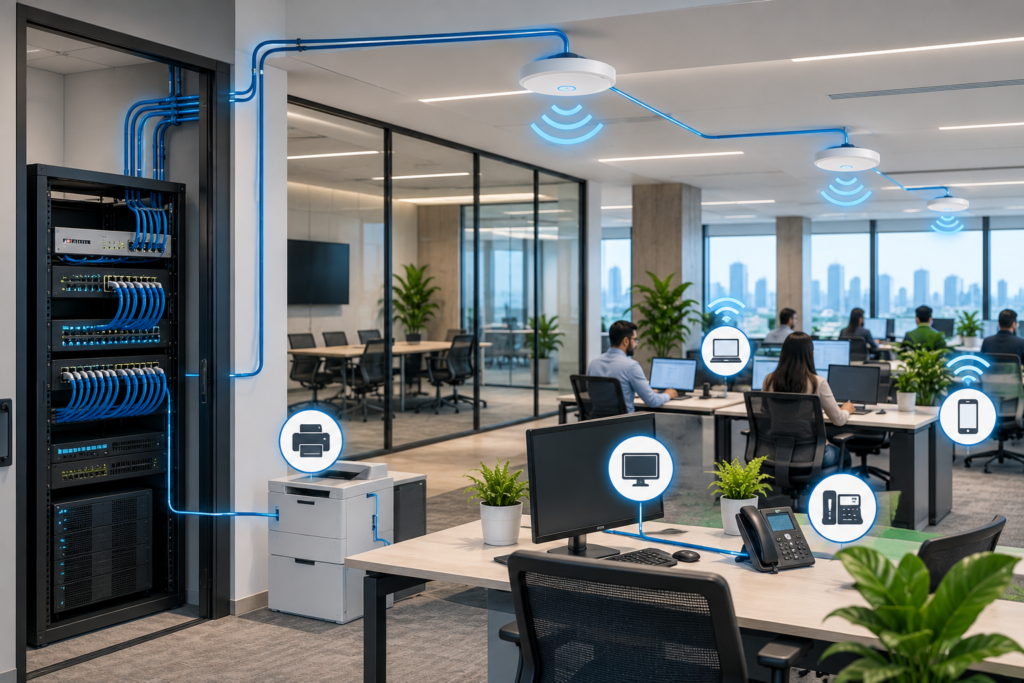
A hybrid network uses structured cabling as the underlying infrastructure while wireless access points provide mobility throughout the workplace.
For example, a business might use Ethernet connections for desktop computers, servers, switches, IP phones, and access points while employees use Wi-Fi for laptops, smartphones and tablets.
This approach combines the stability of wired connections with the flexibility of wireless networking.
It also aligns with modern network infrastructure, where structured cabling and enterprise Wi-Fi are often designed as complementary parts of the same system.
Common Mistakes Businesses Should Avoid
Whichever approach you choose, avoid making the decision based only on installation price.
Common mistakes include:
- Installing Wi-Fi without assessing coverage and interference
- Failing to plan enough network ports for fixed devices
- Choosing equipment based only on advertised speed
- Ignoring future business growth
- Placing wireless access points without proper planning
- Treating network security as an optional extra
- Installing cabling without proper labeling and certification
- Designing the network without considering how employees actually work
A good network should support the way your business operates rather than forcing employees to work around the limitations of the infrastructure.
Frequently Asked Questions
Which network is better, wired or wireless?
Neither is universally better. Wired networking is generally better for fixed devices that require consistent connectivity, while wireless is better for mobility and flexible workspaces. Many businesses benefit from using both.
What are the disadvantages of structured cabling?
Structured cabling usually requires more planning and installation work upfront. Changes to the physical office layout may also require additional cabling or network outlets, although a well-planned system can make future expansion easier.
What is a disadvantage of a wireless network?
Wireless performance can be affected by distance, physical obstacles, interference, network congestion, and the number of connected devices. Proper access point placement and network design can significantly reduce these issues.
Is wired Wi-Fi better than wireless Wi-Fi for business?
If by “wired Wi-Fi” you mean access points connected to the network through Ethernet, then yes, this is often the preferred business setup. The access point can use a stable wired backhaul while employees still enjoy wireless connectivity.
Should a business use both wired and wireless networking?
For many businesses, yes. A hybrid network can provide wired connections for critical fixed equipment while giving employees the mobility and convenience of Wi-Fi.
Structured Cabling or Wireless: Which Should Your Business Choose?
The better question is not simply “wired or wireless?” It is “which connection method is right for each part of our business?”
Structured cabling provides a dependable foundation for fixed and critical equipment, while wireless networking gives employees the freedom to work from different locations and connect mobile devices easily.
For most modern offices, combining the two is often the most practical approach. Start with a properly planned network infrastructure, identify which devices need physical connections, then design wireless coverage around the people and devices that need mobility.
If you’re planning a new office network, upgrading an existing infrastructure, or dealing with unreliable connectivity, a professional network assessment can help determine the right balance between wired and wireless connectivity. A properly planned network today can save considerable time, cost, and frustration as your business grows.