
Network Redundancy: Why Your Business Needs It in Qatar
Imagine your business network goes down at 10:00 AM. Employees cannot access cloud applications, customers cannot reach your online services, IP phones stop working, and security systems may lose connectivity. The frustrating part is that the failure might come from something as simple as one failed switch, internet connection, or network device.
This is where network redundancy becomes important. Instead of relying on one connection or one critical device, redundancy introduces a backup path or component that can take over when something fails. In this guide, we will explain how network failover works, what dual ISPs and redundant switches actually do, and why these measures matter for business continuity in Qatar.
Redundancy does not mean buying two of everything. A well-designed network identifies the components that could bring operations to a halt and provides an appropriate backup for those specific points of failure. For some SMEs, that might mean a second internet connection. For a larger organization, it could involve redundant switches, firewalls, power systems, and multiple network paths.
What Is Network Redundancy?
Network redundancy is the practice of adding backup network components, connections, or paths so that a single failure does not bring the entire network down.
Think of it like having a spare route to reach the same destination. If the normal route becomes unavailable, traffic can move through another route instead.
Depending on the business, redundancy can be applied to:
- Internet connections
- Network switches
- Firewalls
- Routers
- Network links
- Power supplies
- Data-centre equipment
- Wireless connectivity
- Critical network services
The objective is simple: remove or reduce single points of failure.
A resilient network does not necessarily prevent equipment from failing. Instead, it is designed so that a failure has a limited effect on business operations.
Why Network Redundancy Matters for Qatar Businesses
Businesses in Qatar increasingly depend on always-on connectivity. Cloud applications, Microsoft 365, VoIP, online payments, remote access, CCTV, ERP platforms, digital customer services, and internal business systems can all depend on the network.
A network outage therefore affects much more than internet browsing.
For example, if a company’s primary internet connection fails, employees may still have functioning computers and servers, but cloud applications and external communications could become inaccessible.
For a business that processes orders, communicates with customers, manages logistics, or operates across multiple branches, even a relatively short interruption can become disruptive.
This is why business continuity IT planning should consider network availability alongside backups, cybersecurity, disaster recovery, and other operational safeguards.
How Network Failover Works
Network failover is what happens when a backup connection or device automatically takes over after the primary one becomes unavailable.
A simple example is a business with two internet connections.
Under normal conditions:
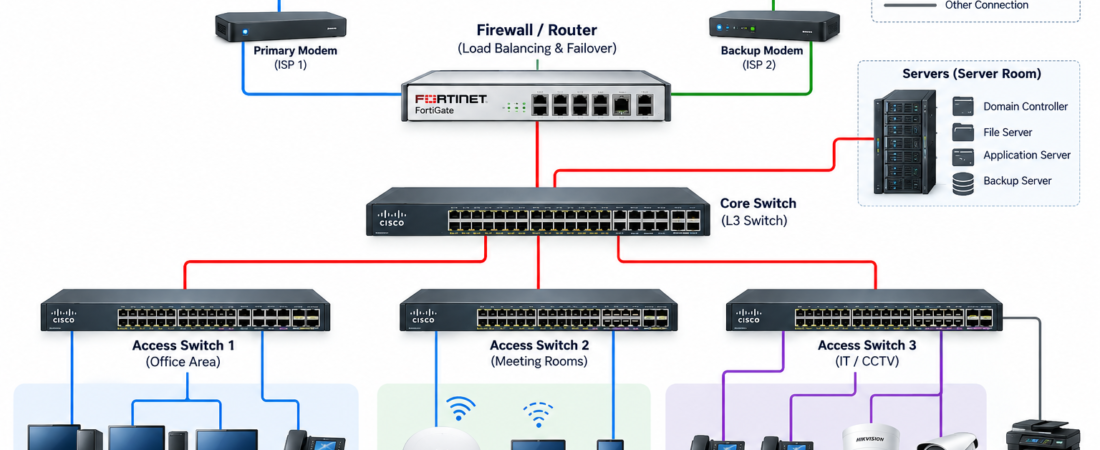
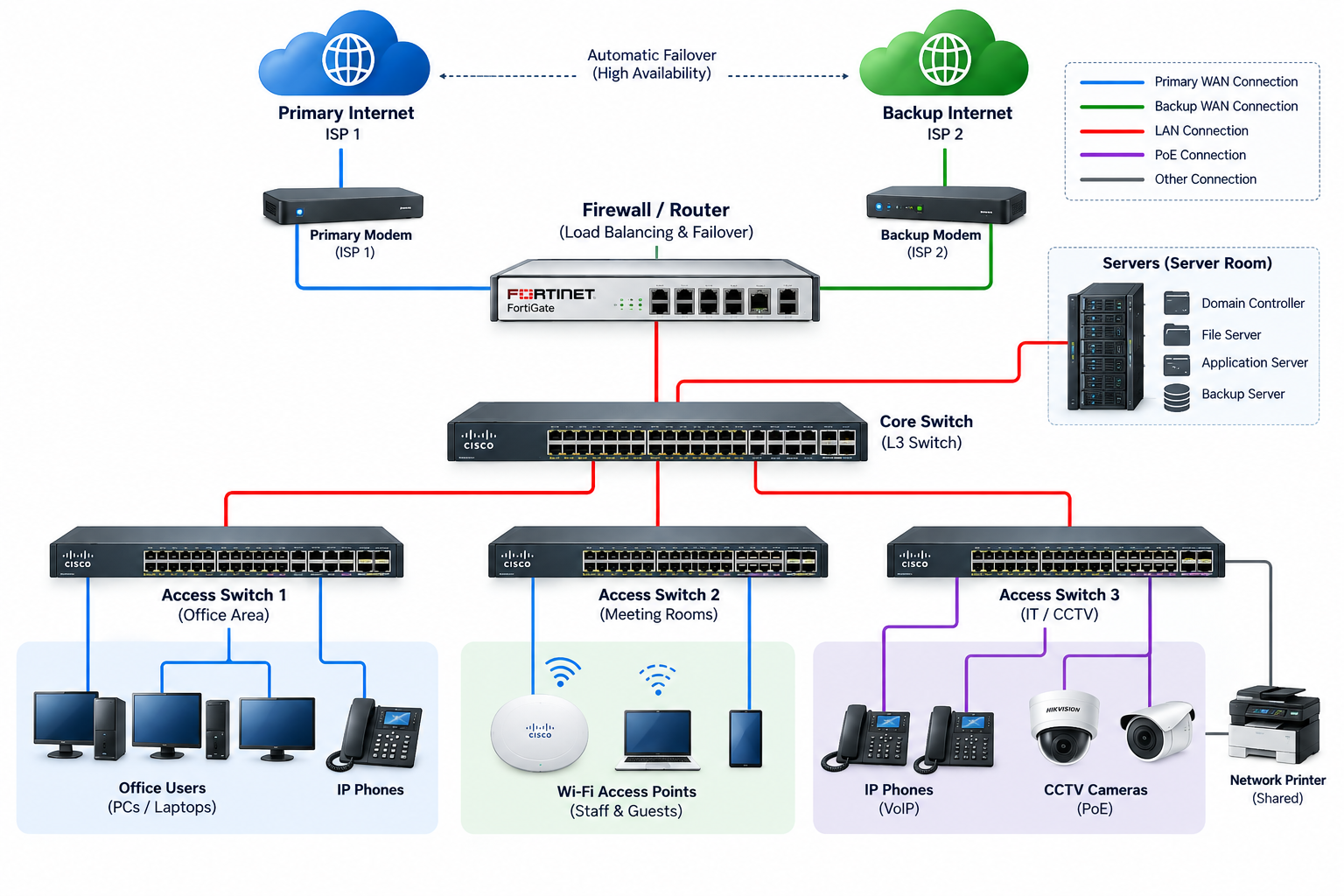
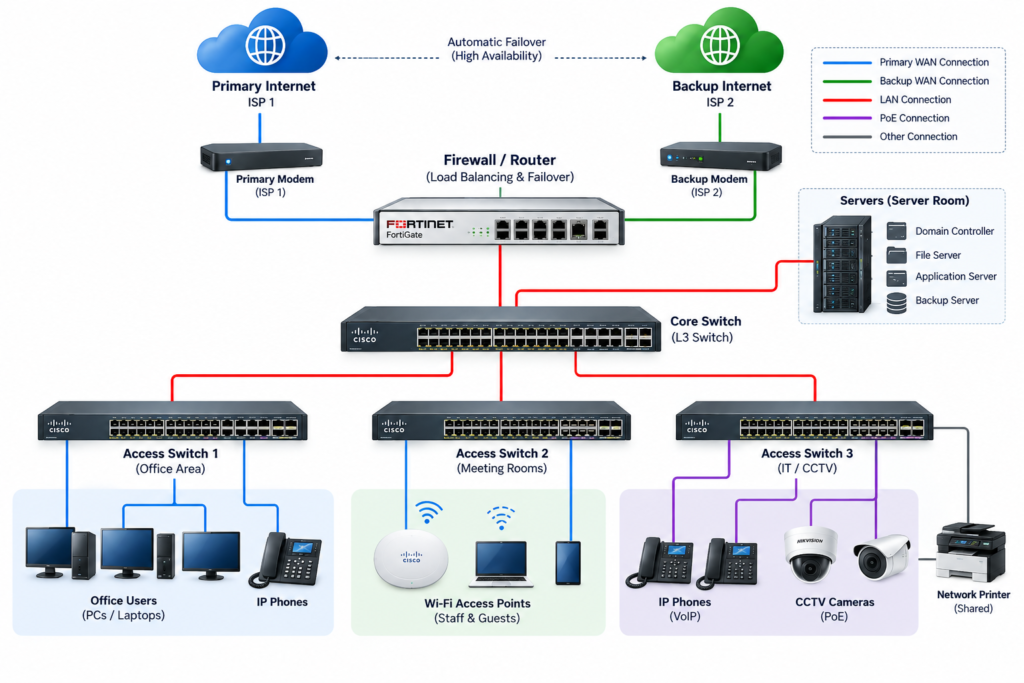
Primary ISP → Firewall → Business Network
If the primary ISP fails:
Backup ISP → Firewall → Business Network
The important part is that the switch from one connection to another can be automated rather than waiting for someone to manually reconnect equipment.
Modern firewall and SD-WAN technologies can monitor WAN connections and redirect traffic when a monitored connection becomes unavailable or does not meet defined health conditions. Fortinet, for example, documents dual-WAN configurations where a secondary connection can take over when the primary link fails.
The exact failover time and user experience depend on the network design, applications, routing, and configuration.
Common Types of Network Redundancy
Not every business needs the same level of resilience. The following are some of the most common approaches.
1. Dual Internet Connections
One of the simplest and most useful forms of redundancy is having two internet connections.
For example, a company might use one primary business connection and a second connection from another provider as a backup.
If the primary service experiences an outage, the firewall or SD-WAN solution can redirect traffic through the secondary connection.
Using different providers can also reduce the risk of a single ISP outage affecting both connections. However, the physical paths should also be considered. Two services that ultimately depend on the same building entry point or infrastructure may not provide as much independence as expected.
2. Redundant Network Switches
A failed switch can disconnect an entire group of users and devices.
For larger offices, campuses, data rooms, and critical environments, network designers can use redundant switches or multiple switching paths so that one hardware failure does not isolate an entire part of the network.
This can become particularly important where switches connect:
- Servers
- Wi-Fi access points
- IP phones
- CCTV systems
- Access-control systems
- Critical workstations
- Other network infrastructure
Redundancy should be designed carefully, though. Simply purchasing two switches does not automatically create a redundant network. The connections, VLANs, routing, spanning-tree or equivalent technologies, and physical paths all need to be considered.
A properly planned network infrastructure solution can bring these elements together as part of a wider network design.
3. Redundant Firewalls
For businesses where internet access and security services are critical, the firewall itself can become a single point of failure.
High-availability firewall configurations use multiple devices so that a secondary unit can take over when the primary device experiences a qualifying failure.
For example, Fortinet documents high-availability configurations in which a backup FortiGate can take over traffic processing if the primary unit becomes unavailable.
The same principle can be applied with other enterprise firewall platforms.
4. Redundant Network Links
Sometimes the problem is not the switch itself but the cable or network path connecting two devices.
A business can introduce additional links between network components to provide another path if one link fails.
This is especially useful in larger networks where access switches, distribution switches, servers, or data-centre systems need resilient connectivity.
The physical installation matters here. Two cables following exactly the same vulnerable route may not provide meaningful protection against a physical incident.
What Is a High Availability Network?
A high availability network is designed to keep important network services operational despite equipment, connection, or component failures.
High availability is broader than simply having a backup internet connection.
For example, a high-availability design might combine:
- Dual ISP connections
- Redundant firewalls
- Redundant switches
- Multiple network links
- Backup power
- Diverse physical cabling routes
- Monitoring and automatic failover
The appropriate combination depends on how much downtime the business can realistically tolerate.
There is also an important distinction between redundancy and backup.
A backup usually helps you recover data or systems after a problem. Redundancy is intended to keep services available while the failure is happening.
In other words, a backup may help you recover after an outage, while redundancy can help prevent a single equipment failure from becoming a complete outage.
How Redundancy Supports Business Continuity
A strong business continuity IT strategy is not only about recovering after something goes wrong. It is also about reducing the impact of foreseeable failures.
Consider a company with one internet connection, one firewall, and one core switch.
Even if every component is high quality, there are still several single points of failure.
Now consider a design with:
- Two independent internet connections
- High-availability firewalls
- Redundant core switching
- Multiple network paths
- Monitoring and automatic failover
The second design has more components, but it also has more options when something fails.
That does not mean every business needs the second architecture. The important question is whether the additional investment matches the operational importance of the network.
CISA’s cyber-resilience guidance similarly identifies high-availability implementations and alternate telecommunications services among mechanisms that can support resilience when critical resources are interrupted.
Does Every Qatar SME Need Full Network Redundancy?
Not necessarily.
A small office with a limited number of employees may not need two core switches and a fully redundant firewall cluster.
However, even a small business can benefit from identifying its most important single points of failure.
For example, a practical SME approach could be:
Basic resilience
- Reliable primary internet connection
- Backup internet connection
- UPS for critical networking equipment
- Regular configuration backups
Higher resilience
- Dual ISP connections
- Managed failover
- Redundant switching for critical areas
- Proactive network monitoring
Critical environment
- Redundant firewalls
- Redundant switching
- Multiple network paths
- Diverse connectivity
- Backup power
- Tested failover procedures
The goal should be proportionality. There is little value in creating an extremely complex network if the business can comfortably tolerate a short outage.
Redundancy Is Only Useful If You Test It
One of the most overlooked parts of redundancy is testing.
A backup connection that has never been tested may not work as expected when you actually need it.
Businesses should periodically verify questions such as:
- Does the backup ISP activate correctly?
- How long does failover take?
- Do critical applications reconnect properly?
- Do VoIP phones continue working?
- Are VPN connections affected?
- Does the firewall maintain the expected policies?
- Are monitoring alerts generated?
- Can the IT team restore the primary path safely?
Testing can also uncover configuration problems before a real outage exposes them.
This is particularly important after major network changes, firewall upgrades, ISP changes, or office relocations.
How to Start Planning Network Redundancy
You do not need to redesign the entire network immediately.
Start by identifying the systems that would cause the greatest operational disruption if they failed.
Step 1: Identify single points of failure
Map the network and ask what would happen if each critical component stopped working.
Step 2: Classify business-critical services
Separate essential services from those that can tolerate downtime.
For example, an ERP system or customer-facing service may require a different availability target from a guest Wi-Fi network.
Step 3: Choose appropriate redundancy
Decide whether the business needs dual ISPs, redundant switches, firewall HA, additional links, backup power, or a combination.
Step 4: Consider physical redundancy
Look beyond logical configuration.
If two critical network links run through the same physical cable tray, a single physical incident could still affect both.
Step 5: Document and test failover
Make sure the IT team knows what should happen during a failure and how to verify that the backup system is working correctly.
Practical Takeaways
Before investing in network redundancy, keep these points in mind:
- Start by identifying your single points of failure.
- Dual ISPs can protect against a primary internet connection outage, but genuinely independent physical paths provide stronger resilience.
- Redundant switches can help prevent one hardware failure from disconnecting a critical network segment.
- Firewall high availability can protect the network edge from a single firewall failure.
- Redundancy should match the business’s actual downtime tolerance.
- A backup system is only useful if it is properly configured, monitored, and tested.
- Physical infrastructure matters just as much as logical configuration.
- Network redundancy should be considered alongside backup, cybersecurity, power protection, and disaster recovery.
Regular maintenance is also important because redundancy does not eliminate equipment failures or configuration problems. Periodic inspection, testing, updates, and monitoring can help keep the failover mechanisms ready when they are needed. For organizations looking for ongoing support, annual maintenance services can form part of a broader infrastructure maintenance strategy.

Frequently Asked Questions
What is network redundancy?
Network redundancy means adding backup connections, devices, or paths so that a single failure does not bring down the entire network. It can include dual internet connections, redundant switches, backup firewalls, and multiple network links.
What is network failover?
Network failover is the process of automatically moving network traffic from a failed primary connection or device to a functioning backup. This helps reduce the interruption caused by equipment or connectivity failures.
Is dual ISP the same as network redundancy?
Dual ISP is one type of network redundancy. It provides an alternative internet connection if the primary ISP becomes unavailable. The level of protection depends on whether the two connections are genuinely independent.
How does network redundancy improve business continuity?
It reduces the effect of individual failures on critical services. Instead of waiting for a failed component to be repaired before operations can resume, a properly designed redundant system can switch to an available alternative.
Does a small business need a high availability network?
Not every small business needs a fully redundant architecture. The appropriate level depends on how much downtime the business can tolerate, which services are critical, and the cost of an outage compared with the cost of adding resilience.
Conclusion
Network redundancy is ultimately about preparing for the failure you hope never happens.
A second internet connection, redundant switch, backup firewall, or additional network path may seem unnecessary while everything is working normally. But when a critical component fails, having an alternative path can make the difference between a manageable interruption and a much larger business disruption.
For Qatar businesses, the right approach is not to add redundancy everywhere. It is to identify the network components that matter most, understand the consequences of their failure, and build practical failover mechanisms around those risks.
If your business is reviewing its network architecture, Tasmeem Tech Trading can help assess critical connectivity, identify potential single points of failure, and plan a network infrastructure approach that supports reliability and future growth.