
Ransomware Attacks: How Qatari Businesses Can Protect Themselves
A ransomware attack can turn an ordinary workday into a serious business disruption. Employees may suddenly lose access to files, servers can become unavailable, and critical systems may stop working. For a business in Qatar that depends on its network, cloud applications, customer records, financial systems, or operational data, even a short period of downtime can create significant problems.
The good news is that ransomware protection for businesses does not depend on one security product. Effective protection comes from several layers working together: secure endpoints, strong access controls, network security, employee awareness, reliable backups, monitoring, and a clear recovery plan.
The goal is not simply to prevent every possible attack. Businesses also need to be prepared for what happens if an attacker gets through. That combination of prevention and recovery can make the difference between a manageable security incident and a prolonged operational crisis.
What Is Ransomware and How Can It Affect a Business?
Ransomware is a type of malicious software that can prevent an organization from accessing its data or systems. Attackers may encrypt files and demand payment in exchange for a potential decryption key. Modern ransomware incidents can also involve data theft, where attackers threaten to publish or misuse stolen information.
The impact can go far beyond individual computers.
A ransomware incident could affect:
- Employee laptops and desktop computers
- File servers and shared folders
- Business applications and databases
- Email and cloud-connected accounts
- Customer and financial information
- Production or operational systems
- Network-connected devices
- Backup systems that are accessible from the compromised environment
For example, imagine an office where an employee opens a convincing phishing email. The compromised account is then used to access other systems. If the attacker obtains higher privileges and reaches shared storage, hundreds or thousands of business files could potentially become inaccessible.
That is why ransomware protection for businesses needs to cover the entire environment rather than focusing only on antivirus software.
How Does a Ransomware Attack Usually Start?
There is no single entry point for ransomware. Attackers can take advantage of weaknesses in technology, user behavior, credentials, or remote access.
1. Phishing and Social Engineering
A common starting point is a deceptive email or message designed to make someone click a link, open an attachment, or provide login information.
The message may appear to come from a supplier, manager, bank, courier, or familiar online service. In a busy business environment, it can be difficult for employees to identify every malicious message.
2. Stolen or Weak Credentials
If an attacker obtains a user’s password, they may attempt to access email, remote services, cloud platforms, or internal resources.
Multi-factor authentication adds another layer of protection because a password alone is no longer sufficient for access.
3. Unpatched Systems
Outdated operating systems, applications, network devices, and security tools can leave known vulnerabilities unresolved. Attackers actively look for systems that can provide an entry point into an organization.
Regular patching should therefore be part of everyday ransomware prevention, not something done only after a security incident.
4. Remote Access
VPNs, remote desktop services, cloud applications, and other remote-access technologies are useful for modern businesses, but they also need to be properly secured.
Access should be limited to authorized users, protected with strong authentication, and monitored for unusual activity.
5. Lateral Movement
Once inside, an attacker may attempt to move from one compromised device to another.
This is where network segmentation, least-privilege access, endpoint protection, and monitoring become important. The objective is to prevent one compromised account or computer from giving an attacker unrestricted access to the rest of the organization.
What Are the 7 Stages of a Ransomware Attack?
Not every ransomware incident follows exactly the same sequence, but a typical attack can be understood through seven practical stages:
- Initial access – The attacker gains entry through phishing, stolen credentials, vulnerabilities, remote access, or another method.
- Execution – Malicious code or tools are executed within the environment.
- Persistence – The attacker attempts to maintain access so they can continue operating.
- Privilege escalation – Attackers may try to obtain higher-level permissions.
- Lateral movement – They move between systems, accounts, servers, or network segments.
- Data theft and encryption – Important data may be copied, systems encrypted, or both.
- Extortion and disruption – The attacker demands payment and may threaten to release stolen information or continue disrupting operations.
This seven-stage model is useful because it shows why ransomware cannot be addressed by one security control. There are opportunities to detect, block, or limit the attack at multiple points.
For a broader framework, businesses can also refer to ransomware protection and response guidance from NIST, which includes current ransomware risk-management guidance as well as resources covering prevention, detection, response, and recovery.
How Can Businesses Improve Ransomware Prevention?
A strong ransomware strategy should use multiple security layers.
Protect Employee Devices
Laptops and desktops are often the first point of contact between employees and malicious files or links. Endpoint protection can help detect suspicious activity and prevent known threats from executing.
Security software should be supported by regular operating-system and application updates.
Strengthen User Access
Use strong passwords, multi-factor authentication, and role-based permissions wherever appropriate.
Employees should have access only to the systems and information they actually need. If one account is compromised, limiting its permissions can reduce the attacker’s ability to move further into the environment.
Secure the Network
A properly designed business network can help separate critical systems and restrict unnecessary communication between devices.
Firewalls, network segmentation, secure remote access, intrusion prevention, and traffic monitoring can all contribute to a stronger security architecture.
Businesses reviewing their overall infrastructure can also consider professional cybersecurity services as part of a broader security strategy.
Train Employees
Technology cannot compensate for every human mistake.
Employees should understand how to identify suspicious emails, unexpected attachments, unusual login requests, fake password-reset messages, and other social-engineering techniques.
Training is particularly important because attackers continually change the appearance and wording of phishing campaigns.
Keep Systems Updated
Create a consistent patch-management process for operating systems, applications, servers, network devices, and other critical infrastructure.
Do not assume that a system is safe simply because it has antivirus software installed. Security updates address vulnerabilities that security software may not be able to prevent on its own.
CISA’s ransomware prevention best practices cover common initial access methods and practical measures organizations can use to prepare for, prevent, mitigate, and respond to ransomware and data-extortion incidents.
Why Data Backup Security Is So Important
Even with strong security controls, no business should assume that ransomware can be prevented with absolute certainty.
This is where data backup security becomes critical.
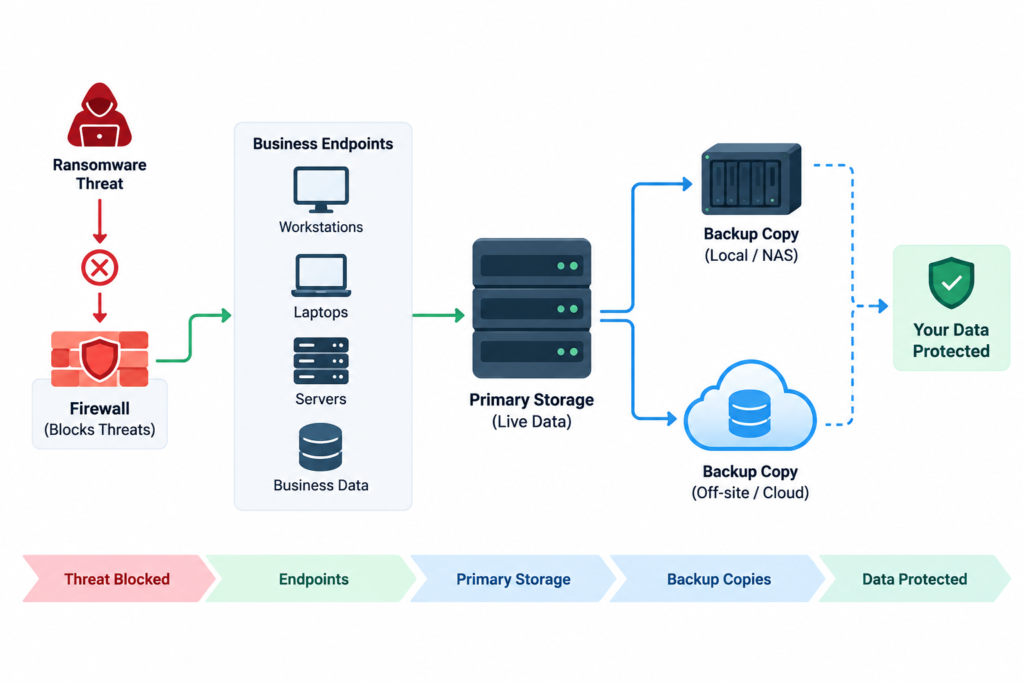
A business should have reliable copies of important data that can be restored if production systems are encrypted, damaged, deleted, or otherwise compromised.
However, simply having a backup is not enough.
If backups are permanently connected to the same environment and an attacker gains sufficient privileges, those backups may also become targets.
Effective backup planning should therefore consider:
- What data needs to be backed up
- How frequently backups should run
- Where backup copies are stored
- Who can access them
- Whether backup data is protected from unauthorized changes
- How long backups are retained
- How often restoration is tested
- How quickly critical systems need to be recovered
NIST’s guidance on conducting, maintaining, and testing backup files specifically addresses backup planning and testing to improve the chances that backup files will actually be useful when a data-loss event occurs.
For businesses reviewing their storage and recovery architecture, enterprise storage and backup solutions can also form part of a broader continuity strategy.
Backup Is Not the Same as Recovery
This is one of the most important points for businesses to understand.
A backup tells you that a copy of your data exists.
Recovery tells you whether you can actually get the business running again.
Consider a company that has been backing up its database every night for two years. On paper, the backup strategy looks excellent. But when a ransomware incident occurs, the IT team discovers that the restoration process has never been tested, the required credentials are unavailable, and the most recent usable backup is much older than expected.
The company has backups but not necessarily a reliable recovery capability.
That is why restoration testing should be part of the plan.
Businesses should periodically confirm that:
- Backup data can actually be accessed
- Files and applications can be restored
- Critical systems can be rebuilt
- Backup copies are not corrupted
- Recovery procedures are documented
- Employees know their responsibilities during an incident
NIST’s guidance on recovering from ransomware emphasizes the importance of recovering data that is accurate, complete, and safe after a destructive event.
How Should Ransomware Protection Work Together?
The strongest approach is not one security tool, it is a layered system.
Think of it this way:
Email security helps reduce malicious messages.
↓
Employee awareness helps users recognize suspicious activity.
↓
Endpoint protection helps detect and block malicious behavior.
↓
MFA and access controls make stolen credentials harder to abuse.
↓
Firewalls and network security help control and monitor network traffic.
↓
Segmentation can limit how far an attacker can move.
↓
Secure backups provide a recovery option if systems or data are compromised.
↓
Incident response and recovery procedures help the business restore operations in a controlled way.
This layered approach is particularly important for growing businesses. As the organization adds employees, branches, cloud applications, servers, and remote users, its attack surface can also become more complicated.
What Should a Qatar Business Do If Ransomware Is Suspected?
Speed matters when ransomware is suspected.
The first priority should be containment rather than trying to investigate everything at once.
Depending on the situation, an organization may need to:
- Isolate affected computers or systems from the network.
- Prevent potentially compromised accounts from accessing additional resources.
- Contact the internal IT or cybersecurity team.
- Preserve relevant logs and evidence where possible.
- Identify which systems and data may have been affected.
- Activate the organization’s incident response plan.
- Determine whether clean backups are available.
- Begin recovery only after the affected environment has been properly assessed.
CISA’s ransomware response guidance similarly recommends isolating impacted systems, assessing the scope of the incident, preserving relevant information, and restoring systems from appropriate backups as part of the recovery process.
The exact response will depend on the organization’s infrastructure and the nature of the incident, so having a documented response plan before an attack occurs is far better than trying to create one during a crisis.
Do Companies Usually Pay Ransomware Demands?
There is no universal answer to whether a company should pay a ransom.
Payment does not automatically guarantee that systems will be restored or that stolen information will not be misused. It can also create additional legal, financial, operational, and security considerations depending on the circumstances and jurisdiction.
The more practical question for a business is:
How prepared are we to continue operating without relying on the attacker?
A company with tested backups, documented recovery procedures, strong access controls, and an incident response plan has more options available when an attack occurs.
How Much Ransomware Protection Does an SME Need?
Small and medium-sized businesses sometimes assume that ransomware only targets large enterprises.
In reality, the size of a business does not remove the need for basic security controls.
An SME should at minimum consider:
- Multi-factor authentication
- Endpoint protection
- Firewall and network security
- Regular patching
- Employee security awareness
- Least-privilege access
- Secure and tested backups
- Email security
- Network segmentation where appropriate
- A documented incident response and recovery plan
The exact technology should depend on the business rather than simply following a generic checklist.
A five-person office with cloud applications will have different requirements from a company operating multiple branches, on-premises servers, large databases, and business-critical applications.
A Practical Ransomware Protection Checklist
Before considering your business prepared, ask:
- Are important systems protected by current security controls?
- Is MFA enabled for important accounts?
- Are operating systems and applications regularly patched?
- Do employees receive cybersecurity awareness training?
- Are critical network resources properly segmented?
- Are backups protected from unauthorized access or deletion?
- Are backups regularly tested through actual restoration exercises?
- Do you know how quickly critical systems need to be restored?
- Is there a documented ransomware response plan?
- Does everyone know who to contact if an attack is suspected?
If several answers are “no” or “we are not sure,” those areas deserve attention.
Frequently Asked Questions
What is the best protection against ransomware?
There is no single security product that provides complete ransomware protection. A layered approach combining endpoint security, MFA, patching, network protection, employee awareness, secure backups, monitoring, and recovery planning provides broader protection.
How can ransomware affect a business?
Ransomware can disrupt access to files, applications, servers, and other business systems. Depending on the incident, attackers may also steal sensitive information and use it for additional extortion.
What are the 7 stages of a ransomware attack?
A practical model is initial access, execution, persistence, privilege escalation, lateral movement, data theft or encryption, and extortion or disruption. Actual attacks can vary and may not follow every stage in exactly this order.
Do companies usually pay ransomware?
Some organizations have paid ransom demands, while others have chosen not to. Payment does not guarantee recovery or prevent stolen data from being misused. Businesses should instead focus on preparation, containment, response, and reliable recovery capabilities.
Is having a backup enough to protect against ransomware?
No. Backups need to be protected, maintained, and tested. A backup that cannot be accessed or restored when required does not provide the same practical value as a verified recovery capability.
Conclusion
Ransomware protection for businesses is not about buying one security product and considering the problem solved. It is about building layers that make an attack harder to start, harder to spread, and easier to recover from.
For businesses in Qatar, that means looking at the whole environment from employee laptops and email accounts to firewalls, servers, cloud applications, network access, and backup infrastructure.
Start with the basics: secure accounts, patch systems, protect endpoints, train employees, control network access, and maintain reliable backups. Then test what happens when something goes wrong.
The businesses that are best prepared for ransomware are not necessarily the ones with the most complicated technology. They are the ones that understand what matters most, protect it appropriately, and have a realistic plan for getting back to normal when an incident occurs.
If your organization needs help reviewing its cybersecurity, backup, or infrastructure requirements, Tasmeem Tech Trading can help assess the environment and identify practical areas for improvement.