
Cisco vs Fortinet Switches: Which Fits Your Business?
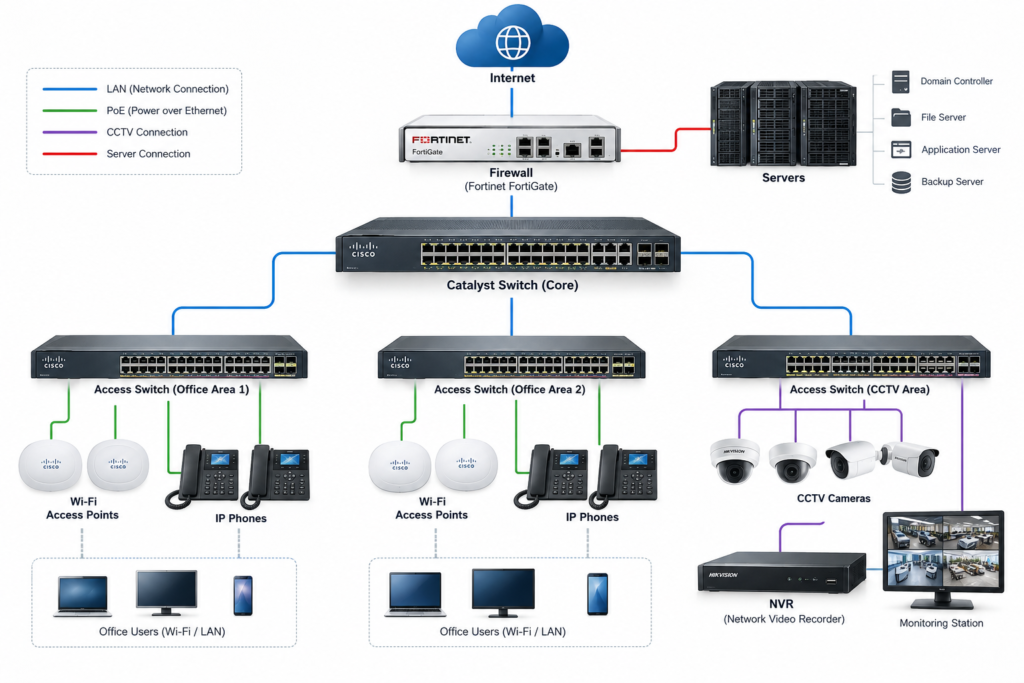
Choosing a business switch is about more than counting ports or selecting the most familiar brand. The switch sits at the centre of your local network, connecting computers, wireless access points, IP phones, CCTV cameras, servers, printers, and other devices that employees rely on every day.
In this Cisco vs Fortinet switches comparison, we will look at how the two brands approach business networking, where each may fit different environments, and what IT managers and business owners in Qatar should consider before making a purchase. The focus is on practical differences rather than declaring one brand the winner.
Both Cisco and Fortinet offer switching platforms for different network sizes and requirements. The right choice will depend on your existing infrastructure, security architecture, number of connected devices, management preferences, future growth, and the skills available within your IT team.
Cisco vs Fortinet Switches: What Is the Main Difference?
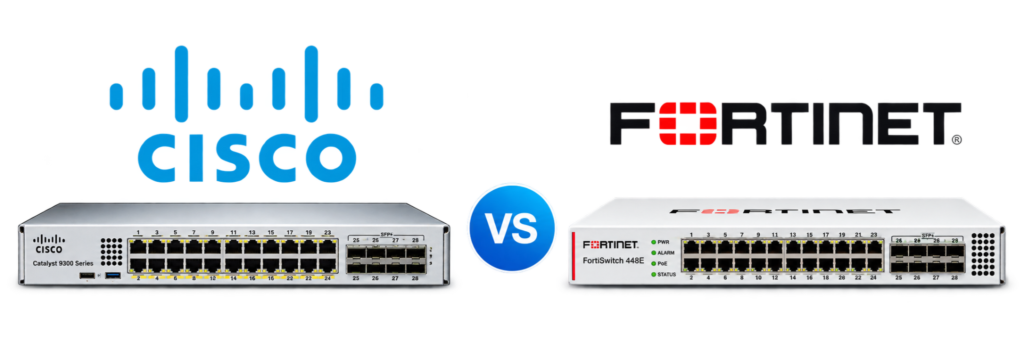
Cisco and Fortinet approach business networking from somewhat different starting points.
Cisco has a long-established enterprise switching portfolio centred around its Catalyst family. Current Catalyst 9000 platforms cover environments ranging from smaller branches and midsize campuses to larger enterprise campus networks. Cisco also provides management options through Cisco Catalyst Center and cloud-based options depending on the platform.
Fortinet’s switching strategy is closely connected to its security ecosystem. FortiSwitch can be deployed as managed switching infrastructure and can integrate with FortiGate through FortiLink, bringing switching and security management closer together.
That distinction can be important when designing a network. A company with an established Cisco environment may want to maintain consistency across its networking infrastructure, while a business already using FortiGate may place greater importance on integrating its switches with its existing security platform.
Cisco Switches: Where They May Fit
Cisco offers a broad range of enterprise switching platforms, giving organizations different options for access, distribution, and campus-core requirements.
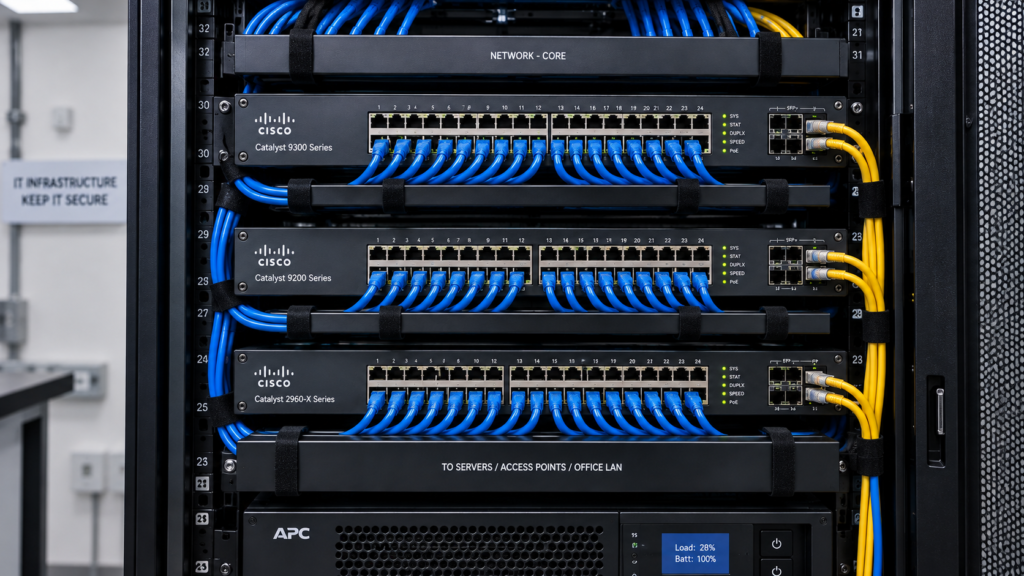
The Catalyst 9200, for example, is positioned for enterprise access deployments in smaller branches and midsize campuses, while Catalyst 9300 platforms are designed for business-critical branch and campus access environments. Larger Catalyst platforms extend into midsize and large campus networks.
Established enterprise networking environments
Cisco may be a natural consideration for organizations that already have Cisco routers, switches, wireless infrastructure, or networking teams familiar with Cisco technologies.
Maintaining a consistent networking environment can make configuration standards, troubleshooting, training, and network expansion easier to manage.
Broad scalability
One advantage of comparing Cisco’s portfolio is the range of hardware available for different network roles.
A small branch office, a multi-floor corporate office, and a large campus do not necessarily require the same switching architecture. Cisco’s Catalyst portfolio provides different platforms for these types of environments rather than treating every deployment as the same problem.
Advanced enterprise requirements
Depending on the model, Cisco Catalyst switches provide features such as stacking, high-speed uplinks, Layer 3 capabilities, PoE options, security features, automation, and network-management integration.
For larger organizations with dedicated network teams, this range of capabilities can be useful when building a more complex network architecture.
Fortinet Switches: Where They May Fit
Fortinet approaches switching with a strong emphasis on integration between network access and security.
Fortinet describes FortiSwitch as managed Ethernet switching that can work with FortiGate to create a more centralized security and management architecture. FortiLink allows FortiSwitch devices to be managed through FortiGate, depending on the deployment and supported configuration.
Businesses already using FortiGate
This is one of the most important considerations in a Cisco vs Fortinet switches comparison.
If a business already uses FortiGate as its firewall, adding FortiSwitch may allow the organization to bring switching management into the same broader ecosystem.
That can be particularly attractive to organizations with smaller IT teams that want to reduce the number of separate management environments they need to operate.
Security-focused network architecture
Fortinet’s switching approach also makes sense for businesses that want security and network access to work closely together.
Modern business networks may contain employee computers, guest devices, wireless access points, IP phones, cameras, printers, IoT equipment, and other connected endpoints. Managing these devices effectively requires more than basic connectivity.
FortiSwitch and FortiGate integration can provide a way to bring network access and security controls closer together, depending on the architecture.
Growing businesses
Fortinet also positions FortiSwitch for smaller and growing businesses, with managed switching designed around scalability and simplified administration.
For a company expanding from one office into several branches, however, the decision should still be based on the complete network design rather than simply choosing the same brand as the firewall.
Enterprise Switches Comparison: What Should You Actually Compare?
A useful enterprise switches comparison should look beyond brand reputation.
The following factors can have a greater impact on the suitability of a switch for your business.
1. Number of users and devices
Start with the devices connected today, then estimate what the network will need to support over the next three to five years.
For example, an office might initially need connections for computers and printers. As it grows, the same network may need to support additional Wi-Fi access points, IP phones, CCTV cameras, access-control systems, meeting-room equipment, and servers.
Buying only for today’s requirements can result in another hardware upgrade sooner than expected.
2. PoE requirements
Power over Ethernet can simplify installations by allowing compatible devices such as IP phones, wireless access points, and certain CCTV cameras to receive power and data through network cabling.
Do not look only at the number of PoE ports. Check the total PoE power budget and whether it can support the devices that may operate simultaneously.
3. Uplink capacity
Access ports are only one part of the network.
If several access switches connect back to a core or distribution layer, the uplinks need enough capacity to handle the traffic generated by connected users and devices.
A switch with plenty of ports can still become a bottleneck if its uplink design does not match the rest of the network.
4. Network management
Management is another major consideration.
Cisco’s Catalyst portfolio supports centralized management through Cisco Catalyst Center, with cloud management or monitoring options available for certain Catalyst platforms.
FortiSwitch can be managed through FortiGate using FortiLink, providing an integrated approach for organizations using the Fortinet security ecosystem.
The best approach depends on how your IT team currently operates and what level of centralized visibility it needs.
5. Existing security infrastructure
The firewall and switching layers should not be selected completely independently.
If your organization already has a substantial Cisco environment, introducing another networking ecosystem may create additional management considerations. Similarly, a business heavily invested in Fortinet security may want to evaluate how switching integration affects administration and network visibility.
Network Hardware Qatar Businesses Should Think About Beyond Specifications
When evaluating network hardware Qatar businesses can deploy, technical specifications are important, but they are not the entire decision.
Availability, warranty support, replacement options, installation expertise, documentation, and ongoing maintenance can all affect the practical cost of running a network.
The physical environment matters as well. Network switches should be installed in an appropriately designed rack or communications room with suitable power, ventilation, cable management, and physical security.
For businesses operating across Doha or multiple Qatar locations, standardizing network hardware can also simplify configuration, troubleshooting, spare-parts management, and staff training.
A professional network infrastructure solution can therefore involve much more than simply purchasing switches. Cabling, racks, uplinks, Wi-Fi, IP telephony, security, and future expansion all need to work together.
Cisco vs Fortinet Switches for Different Business Sizes
The most useful way to approach the comparison is to consider the type of organization and network being built.
Small businesses
A small office may prioritize straightforward management, reasonable scalability, PoE support, and integration with its existing firewall.
If the business already uses FortiGate, FortiSwitch is worth considering because Fortinet specifically supports integration between the two platforms through FortiLink.
A small business already operating Cisco networking equipment may instead prefer to remain within the Cisco ecosystem to maintain consistency.
Mid-sized businesses
For a growing organization with several departments, access points, IP phones, cameras, and servers, features such as VLAN support, PoE, redundancy, stacking, Layer 3 capabilities, and centralized management become more important.
At this stage, the purchasing decision should consider the entire network architecture rather than the switch’s initial price.
Large enterprises
Large enterprises may need multiple switching layers, redundant links, high-speed uplinks, centralized monitoring, network segmentation, and more sophisticated lifecycle management.
Cisco’s Catalyst portfolio includes platforms positioned for access, distribution, and campus-core environments. Fortinet also offers switching solutions designed to integrate into larger security-focused network architectures.
For these deployments, existing infrastructure and the organization’s network-management capabilities can be just as important as the hardware specification.
Why Managed Switches Matter for Business Networks
For most professional environments, managed switches provide considerably more control than basic unmanaged switches.
Managed switching allows network administrators to configure VLANs, monitor ports, prioritize traffic, manage connected devices, and implement the network policies required by the business.
This becomes especially useful when different types of traffic share the same physical infrastructure.
For example, a Qatar office may use the network for employee computers, guest Wi-Fi, VoIP phones, CCTV cameras, printers, and business applications. Separating and managing these workloads properly can improve visibility and make troubleshooting easier.
Managed switches also provide greater flexibility when the company expands, changes its office layout, adds new devices, or introduces additional security requirements.
A Practical Checklist Before Choosing a Switch
Before deciding between Cisco and Fortinet, ask these questions:
- How many users and network devices do we have today?
- How many devices are expected within the next three to five years?
- Do we need PoE for phones, cameras, or Wi-Fi access points?
- What uplink speeds does the network require?
- Do we already use Cisco or Fortinet security infrastructure?
- Does our IT team have experience with either platform?
- How will the switches be monitored and managed?
- Do we need stacking or redundancy?
- Will the same hardware platform be used across multiple locations?
- What are the licensing, support, warranty, and maintenance requirements?
- What is the total cost of ownership over the expected lifecycle?
Answering these questions first makes the brand comparison much more meaningful.
Practical Takeaways
A few points are worth keeping in mind when evaluating the two brands:
- Cisco offers a broad enterprise switching portfolio covering different access and campus requirements.
- Fortinet places strong emphasis on integrating switching with its security ecosystem, particularly FortiGate through FortiLink.
- Managed switches are generally more appropriate for professional networks that require segmentation, monitoring, PoE, traffic management, and scalability.
- The number of ports alone should not determine your purchase. PoE capacity, uplinks, redundancy, management, and future growth also matter.
- Existing firewall and network infrastructure should be considered before introducing a new switching platform.
- For Qatar businesses, local support, replacement availability, installation quality, and long-term maintenance should form part of the purchasing decision.
Frequently Asked Questions
Is Cisco better than Fortinet for business switches?
Neither brand is automatically the right choice for every business. Cisco and Fortinet have different ecosystems and management approaches, so the decision should be based on the organization’s existing infrastructure, security platform, network requirements, and IT expertise.
Are Cisco and Fortinet switches managed switches?
Yes. Both brands offer managed switching platforms for business and enterprise environments. The exact capabilities depend on the specific model, software, licensing, and deployment architecture.
Is FortiSwitch a good option for a business using FortiGate?
FortiSwitch is specifically designed to integrate with FortiGate through FortiLink, allowing supported switches to be managed through the Fortinet security ecosystem. This can be a relevant consideration for organizations already using FortiGate.
What should I consider when buying network hardware in Qatar?
Consider the number of users and devices, PoE requirements, uplink capacity, network architecture, management platform, support, warranty, availability of replacement equipment, and expected business growth.
How do I choose between Cisco and Fortinet switches?
Start by defining your network requirements and reviewing your existing infrastructure. Then compare suitable models based on performance, management, security integration, scalability, support, licensing, and total cost of ownership rather than comparing brands in isolation.
Conclusion
The Cisco vs Fortinet switches decision is ultimately about finding the right fit for the network you are building.
Cisco may be relevant for organizations looking for a broad enterprise networking portfolio and established Cisco-based infrastructure, while Fortinet may be particularly relevant for businesses that want switching closely integrated with an existing FortiGate security environment. Neither approach is universally suitable for every organization.
For businesses in Qatar, the most practical approach is to assess the complete environment first: users, devices, PoE requirements, uplinks, security architecture, network management, future growth, and ongoing support. Once those requirements are clear, comparing the appropriate Cisco and Fortinet models becomes much easier.
If you are planning a network upgrade or evaluating network hardware in Qatar, a properly designed solution should consider the entire infrastructure rather than treating the switch as an isolated purchase. This helps create a network that is easier to manage today and easier to expand tomorrow.