
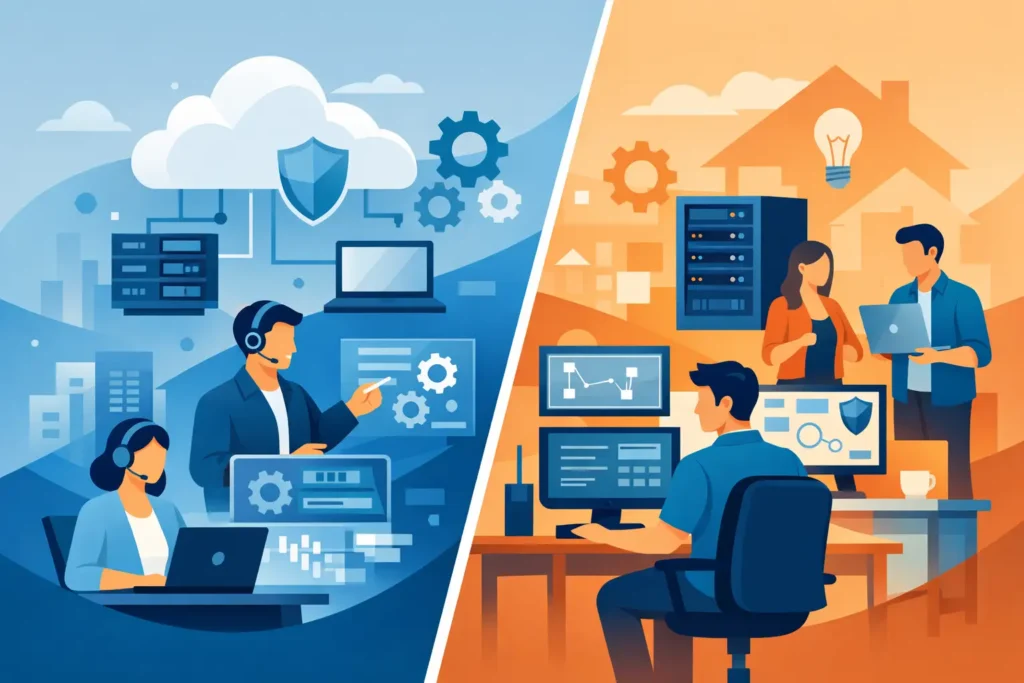
When a server fails at 10:30 on a Monday morning, the real question is not who owns the IT function. It is who fixes the issue fast, protects the business, and keeps operations moving. That is why the managed it services vs in house decision matters more than most companies expect. It affects downtime, cybersecurity exposure, staffing costs, vendor coordination, and how confidently a business can grow.
For small and mid-sized organizations, this is rarely a simple either-or choice. Some businesses need full internal control because technology is central to the product they deliver. Others need dependable external support because hiring, training, and retaining a complete IT team is costly and difficult. The right model depends on operational complexity, risk tolerance, growth plans, and the level of accountability the business expects.
Managed IT services vs in house: what changes in practice
In-house IT means your company employs its own technical staff to manage systems, users, devices, networks, security, and support. That can range from one IT generalist to a full internal department with specialists in infrastructure, cybersecurity, cloud, and end-user support.
Managed IT services means partnering with an external provider that handles some or all of those responsibilities under a service agreement. Depending on the arrangement, the provider may monitor systems, resolve incidents, manage backups, maintain firewalls, support users, handle procurement, and help plan upgrades or expansions.
On paper, both models can keep technology running. In practice, the difference is depth, coverage, and resilience. A single internal IT employee may know the business well, but one person cannot be available at all times or specialize in every discipline. A managed service partner brings broader expertise and structured support, but it must understand the business environment well enough to respond with context and speed.
Cost is not just salary vs contract
Many decision-makers start with cost, which is sensible, but the real math is broader than payroll. In-house IT costs include salaries, benefits, recruiting, training, certifications, tools, software platforms, and the risk of turnover. If one employee leaves, institutional knowledge often leaves with them.
Managed services usually shift that cost into a predictable monthly operating expense. That can improve budgeting and reduce surprise spending, especially for businesses that need ongoing support but do not require a full internal team. The value is not only lower overhead. It is also access to multiple skill sets without paying full-time salaries for each one.
That said, managed services are not automatically cheaper in every case. Larger enterprises with heavy internal workloads, specialized applications, or strict internal governance may justify a bigger in-house department. If your business needs constant on-site engineering across multiple locations, the economics may favor a strong internal team supported by selected outside specialists.
The biggest difference is usually coverage
Coverage is where managed IT services often outperform a small in-house setup. Businesses do not experience issues on a perfect schedule. Network outages, ransomware attempts, failed backups, firewall misconfigurations, and hardware faults can happen outside normal business hours.
An in-house team may provide excellent support during office hours, but after-hours response depends on staffing depth. If the team is lean, response times can slow and critical alerts may wait. Managed service providers are designed to deliver broader monitoring and support coverage, often with escalation paths, ticketing discipline, and defined service expectations.
For organizations that rely on uptime for sales, communications, security systems, remote access, or customer service, that difference matters. Coverage is not just convenience. It is a continuity issue.
Security is where trade-offs become serious
The managed it services vs in house debate becomes sharper when cybersecurity enters the picture. Threats are more frequent, more automated, and more expensive than they were a few years ago. Good security now requires layered controls, patch management, endpoint protection, backups, access policies, monitoring, user awareness, and incident response planning.
A well-built in-house IT department can absolutely deliver strong security. The challenge is that most small and mid-sized businesses do not have a dedicated internal security team. They often expect one or two generalists to handle infrastructure, support tickets, procurement, vendor coordination, and security at the same time.
A capable managed IT provider can bring security processes, specialized tools, and broader exposure to current threats across many client environments. That often leads to more consistent patching, better backup oversight, stronger perimeter protection, and faster identification of issues before they become outages.
Still, security should never be outsourced blindly. The provider must have clear responsibilities, documented standards, and a service model that fits your compliance and operational needs. External support helps, but accountability must stay visible.
In-house IT offers control, but control comes with burden
The strongest argument for in-house IT is control. Internal teams are embedded in the business. They understand user behavior, internal politics, system history, and operational priorities in a way that outside providers may take time to learn. They can walk the floor, speak directly with department heads, and align decisions closely with company culture.
That proximity is valuable. It can improve speed for local issues and support stronger alignment between IT and business leadership. For companies with custom workflows or high-sensitivity systems, internal ownership may be the right call.
But control has a cost. Internal teams need management, tooling, process discipline, ongoing training, and backup coverage. If that structure is weak, the business may have ownership without consistency. Many companies discover too late that they are dependent on a single employee with limited documentation and no redundancy.
Managed services can scale faster
Growth exposes weak IT models quickly. Opening a new office, adding remote staff, rolling out IP telephony, expanding storage, upgrading network hardware, or improving CCTV and access systems all require planning and execution capacity.
An in-house team may manage growth well if it already has the right people and bandwidth. If not, projects start competing with daily support work. Help desk tickets pile up while infrastructure upgrades slip.
Managed service partners are often better positioned to scale because they can bring implementation and support together. That matters when a business needs procurement, installation, configuration, maintenance, and future support coordinated under one service structure. It reduces the friction of managing multiple vendors and lowers the risk of gaps between deployment and ongoing ownership.
For growing organizations, scalability is not just about adding devices. It is about adding capability without creating operational instability.
The best answer is often a hybrid model
For many businesses, the best answer to managed IT services vs in house is not one model replacing the other. It is a hybrid structure.
A hybrid model keeps internal ownership where business knowledge and day-to-day coordination matter most, while outsourcing specialized or labor-intensive functions such as network monitoring, cybersecurity, backup management, infrastructure maintenance, vendor escalation, or after-hours support. This gives leadership both visibility and depth.
It also reduces key-person risk. If your internal IT manager is strong but overstretched, external support can extend capability without forcing immediate headcount expansion. That can be a practical move for companies in transition, especially those modernizing infrastructure or adding new locations.
Questions to ask before choosing
The right decision becomes clearer when leadership asks practical questions instead of abstract ones. How much downtime can the business tolerate? Is your internal team broad enough to cover networking, cybersecurity, cloud, user support, telephony, and disaster recovery? How quickly can you replace a critical IT employee if they leave? Are your systems being proactively monitored, or only fixed after users complain?
You should also look at vendor sprawl. If you are buying hardware from one company, licensing from another, support from a freelancer, cabling from a contractor, and cybersecurity from a separate specialist, you may already be paying the hidden cost of fragmented accountability. A single dependable partner can simplify that model and improve response coordination.
This is where companies like TASMEEM TECH TRADING fit naturally for businesses that want both implementation capability and operational support from one source, rather than stitching together disconnected providers.
Choose the model that protects operations
There is no universal winner between managed services and in-house IT. A capable internal team can be a strategic asset. A strong managed services partner can deliver expertise, consistency, and scale that would be difficult to build alone. What matters is not ideology. It is whether your model protects uptime, supports growth, strengthens security, and gives the business clear accountability when something goes wrong.
If your current setup depends too heavily on one person, lacks after-hours coverage, or struggles to keep up with security and maintenance, that is usually a sign to reconsider the model. The smartest IT decision is the one that keeps your business stable today and better prepared for what comes next.