
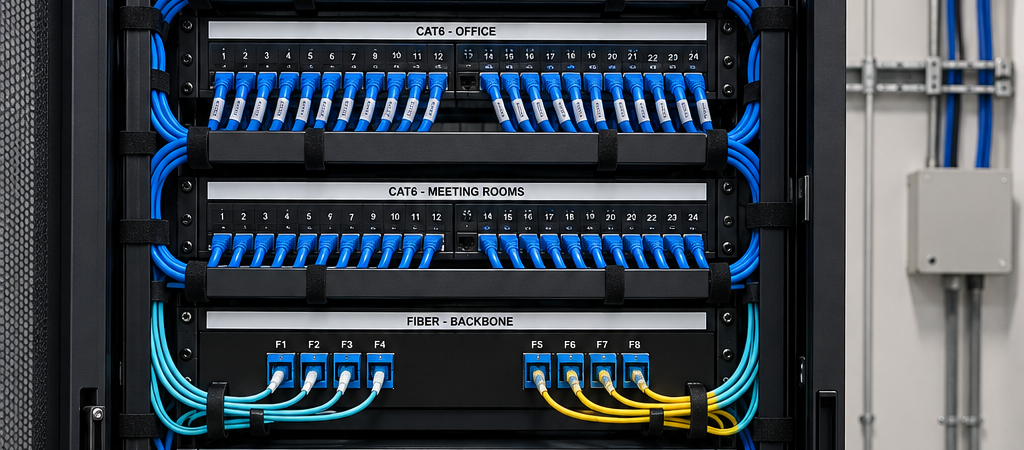
Structured Cabling Qatar: What Businesses Should Know Before Installation
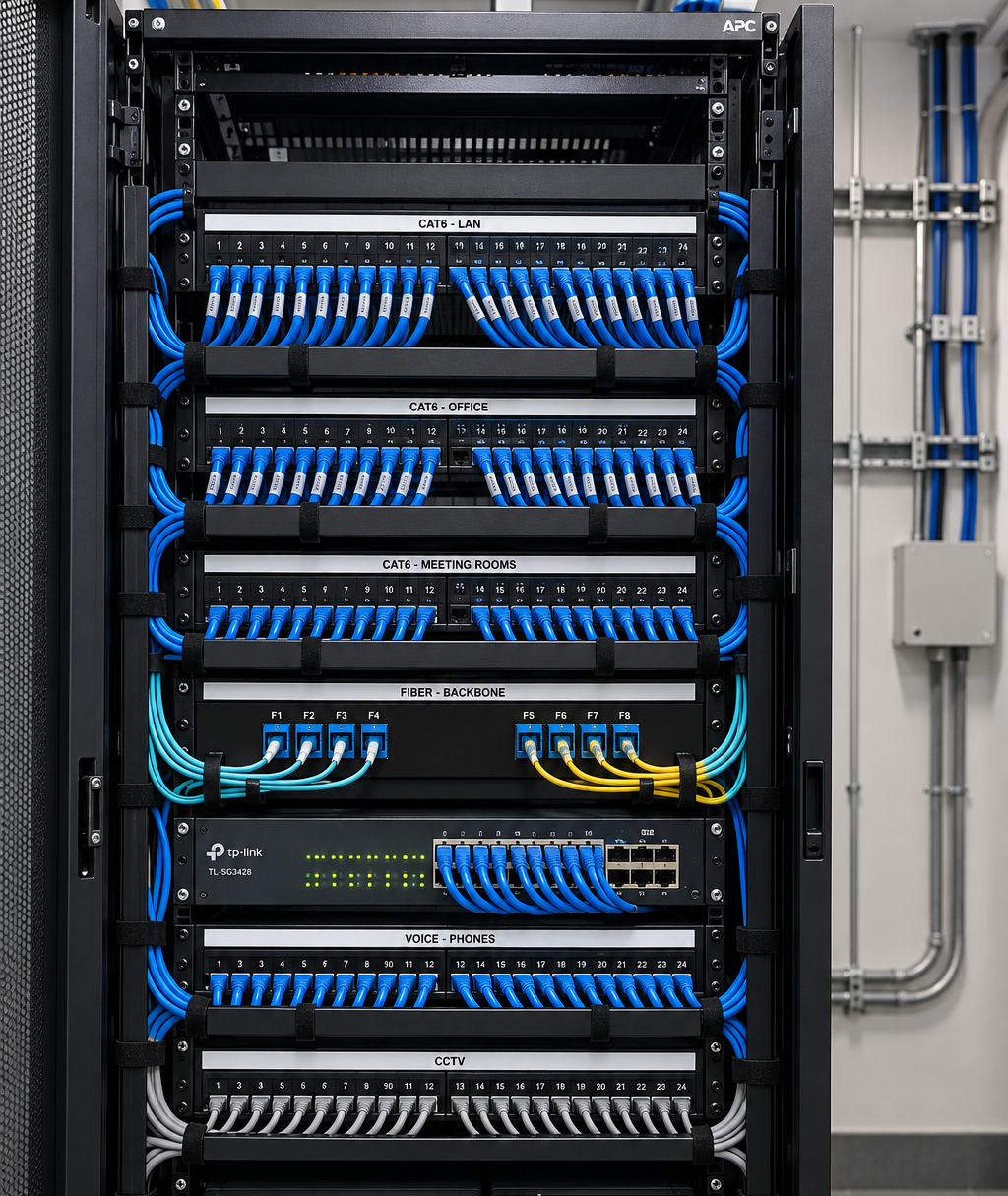
When a business moves into a new office or expands an existing facility, network cabling is often one of those things that gets planned in the background. Yet once the walls are closed, ceilings are finished, and employees start connecting computers, phones, cameras, and wireless access points, changing the cabling can become expensive and disruptive.
That is why structured cabling Qatar projects should be planned before the network equipment is installed.
A good cabling system is not simply a collection of Ethernet cables running from a switch to different rooms. It is a planned infrastructure designed around the building, the technology being used today, and the technology the business may need in the future.
For businesses in Qatar, this can mean planning for everything from office computers and IP phones to Wi-Fi access points, CCTV cameras, access-control systems, servers, and high-bandwidth connections between network rooms.
In this guide, we will look at Cat6, Cat6A and fiber cabling, important cabling standards, cable management, installation planning, and what businesses should check before approving a network cabling project.

What Is Structured Cabling?
Structured cabling is a standardized and organized approach to building the physical telecommunications infrastructure of a business.
Instead of installing individual cables wherever they are needed, the system is designed around defined connection points, telecommunications rooms, equipment rooms, backbone connections, horizontal cabling and work areas.
A typical business installation can include:
- Horizontal copper cabling
- Fiber optic backbone cabling
- Patch panels
- Network racks and cabinets
- Data outlets
- Patch cords
- Cable trays and pathways
- Network testing and certification
- Cable labeling and documentation
The idea is to create a predictable infrastructure that is easier to manage and expand.
This is particularly important as businesses become more dependent on connected systems. A single office may now have computers, IP phones, wireless access points, CCTV cameras, printers, meeting-room equipment and other network-connected devices all operating through the same underlying infrastructure.
A structured approach means these systems do not have to be added in an improvised way every time the business expands.
Why Structured Cabling Matters for Qatar Businesses
Imagine an office with 40 employees today but 80 employees three years from now.
If the original network was installed only for the current 40 users, the company may eventually need additional cables, switches, access points and network outlets. If the pathways and network rooms were not designed with expansion in mind, even a relatively simple upgrade can turn into a construction project.
This is one reason structured cabling Qatar should be viewed as part of the building’s long-term ICT infrastructure rather than simply an installation expense.
A well-planned system can make future changes easier because cables are routed through defined pathways, connection points are documented, and network equipment has a logical location.
Businesses planning a broader network project can also review Tasmeem’s ICT & Networking Infrastructure Solutions to see how structured cabling, fiber, network racks, Wi-Fi and related infrastructure can be considered as part of one connected solution.
Cat6 vs. Cat6A vs. Fiber: Which Should You Choose?
One of the first questions businesses ask is which type of cable they should install.
There is no universal answer. The right choice depends on the network design, distance, bandwidth requirements, environment and expected future requirements.
Cat6 Cabling
Cat6 is a practical choice for many standard business networks.
It can be used for workstations, printers, IP phones, wireless access points and many other Ethernet-connected devices.
For a conventional office with moderate network requirements, Cat6 may provide the performance the business needs without unnecessarily increasing infrastructure costs.
However, businesses should avoid choosing a cable solely because it has the lowest initial price. The cost of replacing cabling later can be much higher than planning the infrastructure properly during the initial installation.
Cat6A Cabling
Cat6A is often considered for businesses that want greater performance headroom and a longer-term cabling infrastructure.
It can be particularly relevant in environments with higher network traffic, dense wireless deployments, demanding workstations, large file transfers and other applications where network capacity is expected to increase.
For a growing Qatar business, Cat6A may also be worth considering where the cabling will remain in place for many years and replacing it later would be difficult.
Fiber Optic Cabling
Fiber is commonly used for backbone connections, longer distances and high-bandwidth links.
For example, a large office building may use fiber to connect different telecommunications rooms, while a warehouse or multi-building facility may use fiber to connect network areas that are too far apart for conventional copper cabling.
Fiber can also provide a useful foundation for future network expansion.
The important point is that fiber should be selected because it fits the network architecture not simply because it is considered more advanced than copper.
Understanding Cabling Standards
A professional cabling project should be based on recognized cabling standards, rather than simply following an installer’s preferred method.
ANSI/TIA-568 is one of the major references for commercial telecommunications cabling and provides guidance for structured cabling systems in commercial buildings. TIA’s telecommunications cabling standards provide the relevant technical framework.
ISO/IEC 11801 provides an international framework for generic cabling in customer premises, covering balanced copper and optical fibre cabling for services such as voice, data and video. The ISO/IEC 11801 standard is particularly relevant when discussing international cabling practices.
For a business owner or facilities manager, the important takeaway is simple: the cable itself is only one part of a standards-based installation.
The project should also consider:
- Cable performance
- Connectors and terminations
- Cable pathways
- Separation from electrical services
- Patch panels
- Grounding and bonding requirements
- Testing
- Labeling
- Documentation
- Future expansion
When comparing two installation quotations, asking which standards and testing procedures will be followed can reveal important differences that may not be obvious from the price alone.
What Are the Six Components of Structured Cabling?
The commonly used structured cabling model divides the infrastructure into several major areas:
1. Entrance Facilities
This is where telecommunications services enter the building and connect to the internal infrastructure.
2. Equipment Room
The equipment room houses major network and telecommunications equipment.
3. Backbone Cabling
Backbone cabling connects different telecommunications and equipment areas within the building or facility.
4. Telecommunications Rooms
These rooms or enclosures provide distribution points for different floors or areas.
5. Horizontal Cabling
Horizontal cabling connects telecommunications rooms to work areas and network outlets.
6. Work Areas
This is where end-user equipment connects to the structured cabling system.
The exact arrangement depends on the building. A small office will obviously have different requirements from a large enterprise facility or warehouse.
Planning Structured Cabling for Offices
Office cabling is no longer just about putting one network socket beside every desk.
A proper design should consider where employees will work and what technology they will use.
Think about:
- Workstations
- Printers
- Meeting rooms
- Wireless access points
- IP phones
- CCTV cameras
- Access-control devices
- Digital signage
- Networked conference equipment
- Future workstations
Wireless networks also depend on physical infrastructure. Access points require network connectivity and, depending on the deployment, power through the network.
Therefore, access-point locations should be considered during the cabling design instead of being decided after the ceiling is finished.
This is particularly useful for businesses designing structured cabling Qatar solutions for open-plan offices, where the number and location of wireless users can change significantly as the company grows.
Planning Cabling for Warehouses and Industrial Facilities
Warehouses have very different requirements from conventional offices.
Long cable routes, high ceilings, metal shelving, machinery, dust, temperature variations and constantly changing storage layouts can all affect the installation.
Cable pathways should therefore be planned around the physical environment.
For wireless networks, access points may need to be positioned around shelving and other obstacles to provide useful coverage.
The same principle applies to CCTV. Camera locations should be considered alongside network connections rather than treated as a completely separate cabling requirement.
A well-designed infrastructure can allow data, voice, Wi-Fi and security systems to coexist in an organized way.
Planning a Data Room
The data room is where poor planning becomes particularly obvious.
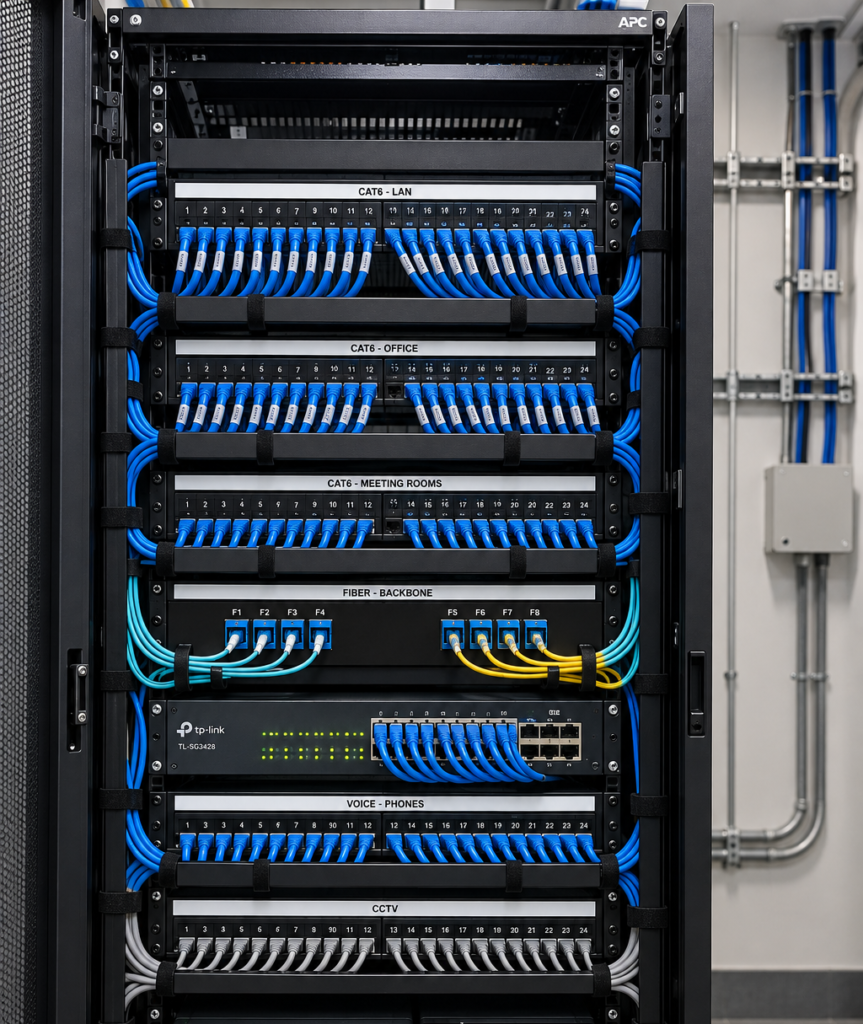
A small network rack can quickly become difficult to manage if switches, patch panels, fiber connections and power equipment are installed without a clear layout.
Before installation, consider:
- Rack size
- Patch-panel locations
- Switch placement
- Fiber termination
- Cable pathways
- Power distribution
- Cooling
- Future rack capacity
- Access for maintenance
Good cable management is not just about making the rack look neat.
It makes it easier to identify connections, troubleshoot faults, replace equipment and add new network connections without disturbing existing infrastructure.
For businesses with larger technology environments, structured network infrastructure should also be coordinated with wider ICT requirements such as servers, storage and network administration. Tasmeem’s ICT infrastructure services provide another relevant reference when planning these broader requirements.
What Happens During a Professional Network Cabling Installation?
A professional network cabling installation should start before the first cable is pulled.
Site assessment
The installer should understand the building layout, network requirements, equipment locations and potential cable routes.
Design
The cabling plan should identify outlets, network rooms, racks, pathways, backbone connections and future expansion requirements.
Installation
Cables are routed through the planned pathways and terminated at the appropriate outlets and patch panels.
Labeling
Each connection should have a logical identification system so technicians can determine where it goes.
Testing
The completed cabling should be tested according to the requirements of the selected cabling system.
Documentation
The business should receive useful documentation showing the installed infrastructure and test results.
This final stage is easy to overlook, but it becomes extremely valuable when the network needs to be modified several years later.
Why Cable Management Should Be Planned From the Start
Cable management should not be something added after the rack is already full.
Good cable management provides space for current connections while leaving room for future changes.
It also reduces the risk of accidentally disconnecting the wrong cable during maintenance.
A well-organized rack should make it relatively easy for a technician to answer basic questions:
- Which patch-panel port connects to this office?
- Which switch serves this floor?
- Where does this fiber connection terminate?
- Which cable belongs to the access point?
- Is there spare capacity for another connection?
That information saves time when something goes wrong.
Three Essential Ingredients for a Successful Cabling Project
A successful structured cabling project generally depends on three things.
Good planning
The infrastructure should be designed around the building, technology requirements and expected growth.
Correct installation
Cable routing, termination, labeling, pathways and cable management all need to be handled properly.
Testing and documentation
A completed installation should be tested and documented rather than simply declared finished because all the cables have been connected.
These three elements are closely connected. Good-quality cable cannot compensate for poor installation, and a well-installed system becomes harder to maintain if there is no documentation.
Questions to Ask Before Approving a Structured Cabling Project
Before selecting an installer, ask:
- Which cable category is being proposed?
- Why is Cat6, Cat6A or fiber appropriate for this project?
- Which cabling standards will be followed?
- Where will the network racks and telecommunications rooms be located?
- How many network outlets are required today?
- How much spare capacity is being planned?
- How will Wi-Fi access points be accommodated?
- How will CCTV and IP phones be integrated?
- What cable management system will be used?
- Will every connection be labeled?
- Will the completed cabling be tested?
- Will test results and documentation be provided?
- How will future expansion be accommodated?
These questions are useful because they shift the discussion away from simply asking, “How much does the cabling cost?”
Instead, you are evaluating what infrastructure you are actually receiving.
Practical Takeaways for Qatar Businesses
Before starting a structured cabling Qatar project, keep these points in mind:
Plan before construction is finished. Running cables is considerably easier when pathways and network locations are considered during the building or renovation stage.
Choose cable based on requirements. Cat6, Cat6A and fiber all have legitimate applications. The right choice depends on the network design.
Follow recognized standards. Standards provide a framework for designing and installing a consistent, testable infrastructure.
Leave room for growth. A network designed only for today’s users may become restrictive surprisingly quickly.
Do not overlook cable management. An organized rack is easier to troubleshoot and maintain.
Test everything. Installation is not complete simply because cables have been terminated.
Document the finished system. Future technicians should be able to understand the network without having to trace every cable manually.
Conclusion
Structured cabling may not be the most visible part of a business’s technology infrastructure, but it supports many of the systems employees rely on every day.
From office computers and Wi-Fi to IP telephony, CCTV and servers, the quality of the underlying cabling can influence how easy the network is to operate, troubleshoot and expand.
For businesses evaluating structured cabling Qatar solutions, the goal should therefore be more than simply getting cables installed. The focus should be on creating a properly planned, standards-based and documented infrastructure that can support the business today and adapt as its requirements change.
If you are planning a new office, warehouse, data room or network upgrade in Qatar, Tasmeem Tech Trading can help you assess the infrastructure requirements and plan the cabling as part of a wider ICT environment.
For example, businesses implementing network-based voice systems should also consider how the physical cabling will support their communications infrastructure. Tasmeem’s IP Telephony Services page provides further information on voice and data cabling, CAT6/CAT6A, fiber and network cabinets.
The best cabling installation is one you do not have to think about every day signs your network needs an upgrade it simply provides a reliable foundation for everything connected to your business network.