
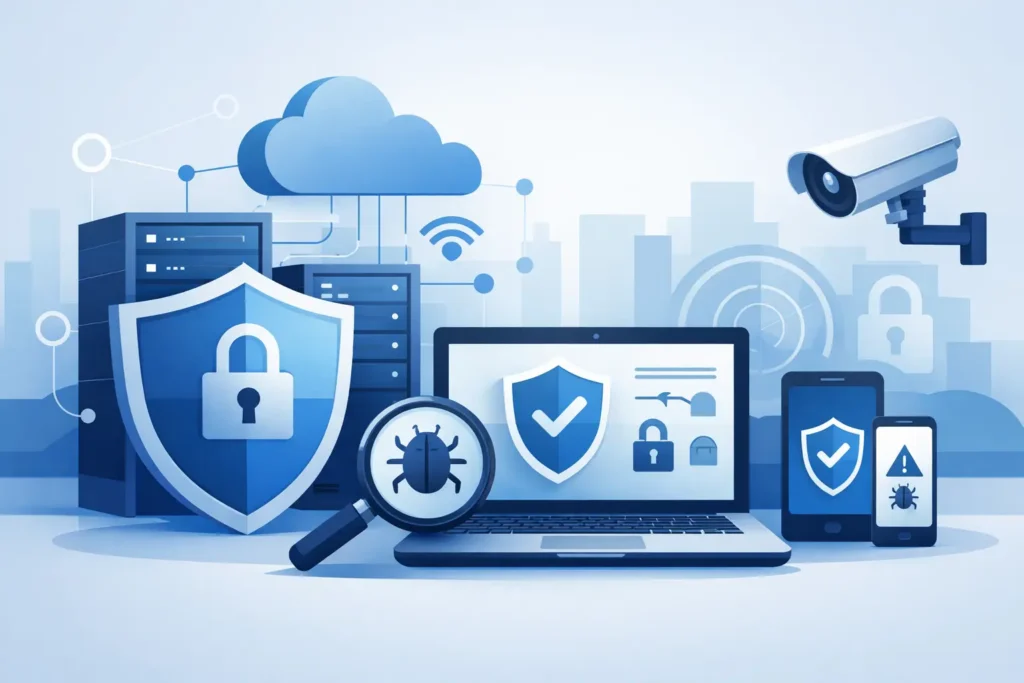
A phishing email reaches an employee, a laptop connects from a hotel Wi-Fi network, and a shared folder starts encrypting without warning. In most businesses, that chain of events is not a single security problem. It is several. That is exactly why the question what is network and endpoint security matters to business owners and IT leaders who need real protection, not partial coverage.
Network and endpoint security are closely connected, but they are not the same thing. One focuses on protecting the traffic, systems, and access points across your IT environment. The other focuses on securing the individual devices people use every day, such as laptops, desktops, servers, and mobile devices. Businesses need both because attackers do not limit themselves to one layer.
What is network and endpoint security in practical terms?
The simplest way to understand it is to think about where risk exists. Your network includes firewalls, switches, wireless access points, VPN connections, internet links, and the data moving between users, applications, and sites. Your endpoints are the devices that connect to that network and interact with your files, cloud services, and business applications.
Network security is designed to control and protect communication. It helps block unauthorized access, segment systems, inspect traffic, and reduce the chance that a threat can move freely across your environment. Endpoint security is designed to protect the device itself. It helps prevent malware execution, detect suspicious behavior, enforce device policies, and isolate compromised machines before damage spreads.
If a business invests in only one side, gaps appear quickly. A strong firewall does not help much if an infected laptop is already inside the environment. At the same time, antivirus on user devices is not enough if the network allows broad access with little segmentation or visibility.
What network security covers
Network security is the set of technologies, controls, and policies used to protect a company’s infrastructure and data as it moves across connected systems. In a business setting, that usually starts with perimeter protection, but it should not end there.
Firewalls are often the first line of defense. They filter incoming and outgoing traffic based on rules, helping block unauthorized connections and risky services. More advanced firewalls can inspect application traffic, identify known threats, and apply policies by user, device, or location.
Intrusion detection and intrusion prevention tools add another layer by monitoring traffic for malicious patterns or suspicious activity. Virtual private networks protect remote access by encrypting connections between users and business resources. Network access control helps ensure that only approved users and devices can connect. Segmentation separates critical systems from general user traffic, which limits lateral movement if a threat gets in.
For example, a company might separate finance systems, surveillance infrastructure, guest Wi-Fi, servers, and employee devices into different network zones. That does not eliminate risk, but it reduces how far one compromised device can reach.
Good network security also includes visibility. If IT teams cannot see unusual traffic, unauthorized devices, or repeated failed login attempts, they are responding after the fact rather than managing risk in real time.
What endpoint security covers
Endpoint security protects the devices people and systems use to access company resources. That includes user laptops, office desktops, file servers, workstations, tablets, and sometimes specialized devices tied to operations.
Traditional antivirus is part of endpoint security, but modern endpoint protection goes further. It can monitor behavior, detect ransomware activity, block malicious scripts, control applications, enforce encryption, and isolate a device when suspicious activity appears. Endpoint detection and response tools also help security teams investigate what happened, which user was involved, and whether other systems were affected.
This matters because the endpoint is often where an attack starts. Users open email attachments, click links, install software, connect USB devices, and work remotely from outside the office. Even well-trained employees can make mistakes, and many attacks are designed specifically to exploit normal business activity.
A device can also be a weak point for reasons that are less dramatic than malware. Missing patches, weak passwords, disabled security agents, and unmanaged remote access tools all increase exposure. Endpoint security helps standardize protection so each device is not left to individual user habits.
Why businesses need both, not one or the other
The main reason is simple: attacks cross boundaries. A phishing email lands on an endpoint, steals credentials, uses the network to reach shared resources, and targets servers or cloud applications. The problem starts on a device but becomes a broader infrastructure issue very quickly.
The reverse is also true. A poorly secured network can expose endpoints to unnecessary risk. If users can connect over weak wireless security, if remote access is loosely controlled, or if flat network design gives every device broad visibility, then even well-protected endpoints are operating in a risky environment.
This is where many small and mid-sized businesses face a practical challenge. Budget and staffing are limited, so security decisions are often made in pieces. A company might buy endpoint software after a malware scare, then later add a firewall during an office move, then revisit backups after a close call with ransomware. Those are reasonable steps, but the result can be fragmented protection.
A stronger approach is to treat network and endpoint security as one coordinated strategy. Policies, monitoring, access controls, backup planning, and response processes should work together rather than operate as separate purchases.
The difference between prevention and containment
One useful way to compare the two is by thinking in terms of prevention and containment. Both network and endpoint security do both, but they do it in different ways.
Endpoint security is often closest to the point of execution. It can stop a malicious file from running, block a script, or quarantine a device that starts behaving abnormally. Network security is often stronger at controlling movement and access. It can stop a compromised device from reaching sensitive systems, restrict remote connections, and alert teams to suspicious traffic patterns.
That distinction matters during an incident. Not every threat can be prevented. Some will get through. The quality of your security posture often depends on how well you contain the problem after that first point of compromise.
For businesses with multiple departments, branch locations, remote users, or mixed on-premise and cloud environments, containment becomes even more important. The more connected the environment, the faster a weakness in one area can affect another.
Common mistakes businesses make
One common mistake is assuming the firewall alone is enough. Firewalls remain essential, but they are not designed to solve every security problem inside the environment. Another is relying on basic antivirus without device management, patching discipline, or centralized monitoring.
A third issue is failing to separate business-critical systems. If file servers, VoIP systems, CCTV infrastructure, user devices, and guest traffic all sit on the same flat network, risk increases significantly. The same goes for shared administrator credentials or inconsistent access policies.
There is also a tendency to focus on tools instead of operations. Security products matter, but so do maintenance, updates, alert review, backup testing, and user policy enforcement. A neglected security stack can create a false sense of protection.
How to evaluate your current security posture
A practical starting point is to ask a few operational questions. Do you know which devices are connected to your network? Can you enforce security policies on company laptops and servers? Are remote users protected consistently? Can you isolate a compromised device quickly? Are critical systems segmented from general traffic? Do you have visibility into unusual activity across both devices and the network?
If the answer to several of those questions is no, the issue may not be a lack of products. It may be a lack of integration, design, or ongoing support.
For many organizations, this is where working with a single IT infrastructure and cybersecurity partner becomes valuable. Coordinated design, deployment, and maintenance help reduce the gaps that appear when networking, device protection, remote access, and support are managed separately.
What effective protection looks like
Effective security is not the most expensive stack or the longest list of features. It is a well-managed environment where access is controlled, devices are protected, systems are segmented, updates are current, and incidents can be detected and contained quickly.
That may include next-generation firewalls, secure wireless design, VPN configuration, endpoint protection, device management, backup strategy, and ongoing maintenance. The exact mix depends on the business. A single-site office, a warehouse operation, a healthcare practice, and a multi-branch company do not have the same risk profile.
At TASMEEM TECH TRADING, the most effective security conversations usually start with operations, not products. What needs to stay available, what data needs protection, who needs access, and where the business is most exposed are the questions that lead to the right design.
Network and endpoint security are best understood as two parts of the same business safeguard. One protects the pathways. The other protects the devices using them. When both are planned properly, security becomes less about reacting to the next problem and more about keeping the business stable, secure, and ready to operate.