
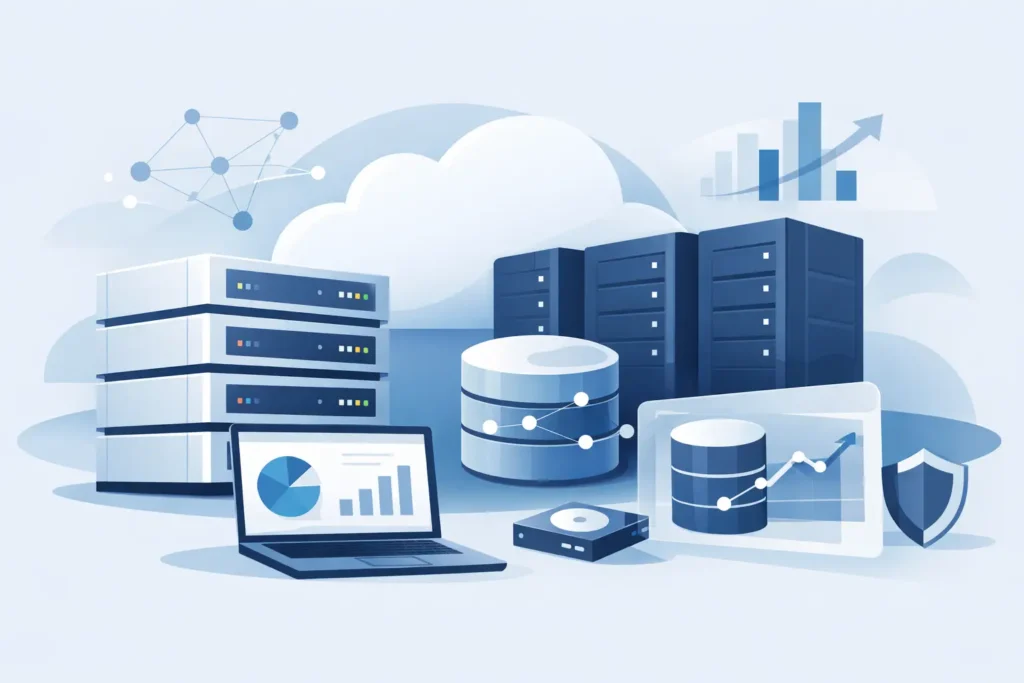
When storage becomes a daily operational issue instead of a background system, the cost shows up fast – slower applications, backup failures, limited visibility, and growing pressure on IT teams. The best enterprise data storage solutions do more than hold data. They support business continuity, protect critical systems, and give organizations room to grow without rebuilding infrastructure every year.
For small to mid-sized businesses and growing enterprises, storage decisions are rarely just about capacity. They affect application performance, recovery times, cybersecurity posture, compliance, and long-term cost control. That is why the right choice depends less on brand names alone and more on how the storage environment fits your workloads, uptime requirements, and internal support model.
What makes the best enterprise data storage solutions
A strong enterprise storage platform should match business operations, not just technical specifications. Fast storage may look attractive on paper, but if it is difficult to manage, hard to scale, or expensive to protect properly, it can become a poor fit over time.
The best enterprise data storage solutions usually balance five priorities: performance, availability, security, scalability, and manageability. Performance matters for databases, virtual machines, file collaboration, and line-of-business applications. Availability matters because downtime affects staff productivity and customer service. Security matters because storage is now directly tied to ransomware resilience and data integrity. Scalability matters because capacity needs rarely stay fixed. Manageability matters because even a well-designed system loses value if daily administration becomes too complex.
This is where many businesses run into an avoidable problem. They buy for immediate capacity and postpone planning for backup, replication, and future expansion. That approach can work for a while, but it often leads to fragmented systems and higher support costs later.
Main types of enterprise storage to consider
NAS for shared business data
Network-attached storage, or NAS, is a practical choice for organizations that need centralized file storage, user permissions, shared folders, and backup targets. It is commonly used for office files, surveillance footage, departmental data, and backup repositories.
NAS is often the most accessible starting point for businesses that want to move away from scattered local storage. It can be cost-effective and relatively straightforward to expand. The trade-off is that not every NAS platform is suited for high-performance application workloads. For standard file services, it can be an excellent fit. For transaction-heavy systems, it may not be enough on its own.
SAN for application-heavy environments
Storage area networks, or SANs, are designed for block-level storage and are often used in virtualized environments, databases, and business-critical applications. They typically offer stronger performance and lower latency than entry-level file-based systems.
A SAN makes sense when application responsiveness and uptime carry more weight than simple file sharing. The investment is usually higher, and design matters more. If a business runs ERP systems, production databases, or large virtual machine clusters, SAN storage is often the better long-term choice.
Hybrid storage for balanced workloads
Hybrid platforms combine flash and traditional spinning disks to balance speed and cost. Frequently accessed data sits on faster media, while less active data remains on lower-cost capacity tiers.
For many growing businesses, hybrid storage is the most practical middle ground. It supports a mix of performance-sensitive and general-purpose workloads without forcing an all-flash budget. The key question is whether the workload profile benefits from tiering. If nearly every workload is latency-sensitive, all-flash may be worth the premium.
All-flash storage for speed and consistency
All-flash arrays are built for high performance, low latency, and consistent response times. They are well suited for virtualization, analytics, large databases, and environments where delays directly affect operations.
The obvious concern is cost. While flash pricing has improved, all-flash systems still require a clear business case. For companies where application speed affects revenue, service quality, or staff productivity, the return can be easy to justify. For less demanding workloads, the premium may not deliver equal value.
How to choose the right fit for your business
Start with workloads, not hardware
The most reliable way to evaluate enterprise storage is to map it to actual workloads. File storage, virtual machines, surveillance systems, backup repositories, email archives, and transactional databases all behave differently. One storage platform may handle some of these well and struggle with others.
This is why broad claims about the best enterprise data storage solutions can be misleading. The best option for a legal office with document-heavy workflows may be very different from the best option for a manufacturer running ERP, CCTV retention, and branch connectivity under one IT environment.
Define recovery expectations early
Recovery objectives should shape storage decisions from the beginning. If systems can tolerate several hours of downtime, the architecture can be simpler. If recovery needs to happen quickly, the design may require redundancy, snapshots, replication, or closer integration with backup and disaster recovery tools.
Many businesses focus first on primary storage and leave resilience for later. That usually leads to gaps. Storage should be part of a wider continuity strategy, especially when cyber incidents, hardware failures, or site-level disruptions are realistic risks.
Consider operational support capacity
Some platforms are feature-rich but demand more hands-on administration. Others are designed for easier monitoring and simpler management. Neither approach is automatically better. It depends on whether your business has in-house expertise, external support, or a hybrid IT model.
For companies that prefer a single accountable partner for deployment and ongoing maintenance, supportability matters just as much as hardware performance. TASMEEM TECH TRADING works with businesses that want enterprise-grade infrastructure paired with practical implementation and long-term support, which is often what turns a good storage product into a dependable business system.
Features that matter more than marketing claims
Snapshots are valuable because they provide quick recovery points for accidental deletion, corruption, or early-stage ransomware events. They are not a replacement for backups, but they add speed to restoration. Replication matters when data must be copied to another device or site for continuity purposes.
Deduplication and compression can improve storage efficiency, but real-world results vary by workload. Backup data and virtual machine images often benefit more than media-rich content. Encryption is increasingly expected, both for data at rest and during transfer, especially in regulated or security-sensitive environments.
Monitoring and alerting should not be overlooked. Storage issues usually announce themselves before failure, but only if the system provides meaningful visibility. Capacity forecasting, health alerts, disk status, and performance reporting all help IT teams act before users feel the impact.
Common mistakes when evaluating enterprise storage
One common mistake is buying too small to protect budget, then expanding reactively at a higher total cost. Another is overbuying enterprise features that the business will never use. Both can happen when planning is driven by product tiers instead of business requirements.
Another mistake is treating storage as separate from cybersecurity. Backup immutability, access controls, snapshot policies, and administrative segregation all matter now. If storage is easy to reach, alter, or encrypt from a compromised account, the business risk increases.
It is also risky to mix too many disconnected systems. A patchwork of aging file servers, standalone NAS units, direct-attached drives, and inconsistent backup tools may look affordable in the short term. In practice, it often increases downtime risk, complicates support, and makes recovery slower when something fails.
A practical view of cost
The cheapest storage is rarely the lowest-cost option over its full lifecycle. Hardware price matters, but so do support coverage, expansion costs, power usage, management overhead, downtime exposure, and recovery capabilities.
A better question is this: what level of storage investment protects operations without forcing unnecessary complexity? For some organizations, that means a well-configured NAS with strong backup and access control. For others, it means a hybrid or all-flash platform with replication and tighter integration into virtual infrastructure.
The goal is not to buy the most advanced system available. It is to put in place storage that remains reliable as the business grows, data volumes increase, and continuity expectations rise.
Choosing with the future in mind
Storage decisions tend to last longer than expected. Once data is in place, migrations take time, planning, and operational risk. That makes it worth choosing a platform that can scale cleanly, integrate with backup and security tools, and support changing workload demands over several years.
If your current environment is producing warning signs – capacity pressure, inconsistent backups, user complaints, or rising recovery concerns – it is usually better to assess the architecture now than wait for a failure to force the decision. The right storage platform should reduce uncertainty, not add to it.
The best enterprise data storage solutions are the ones that fit your business in the real world: your applications, your risk profile, your growth plans, and your support model. When those pieces line up, storage stops being a recurring problem and starts doing what it should have been doing all along – quietly supporting the business every day.