
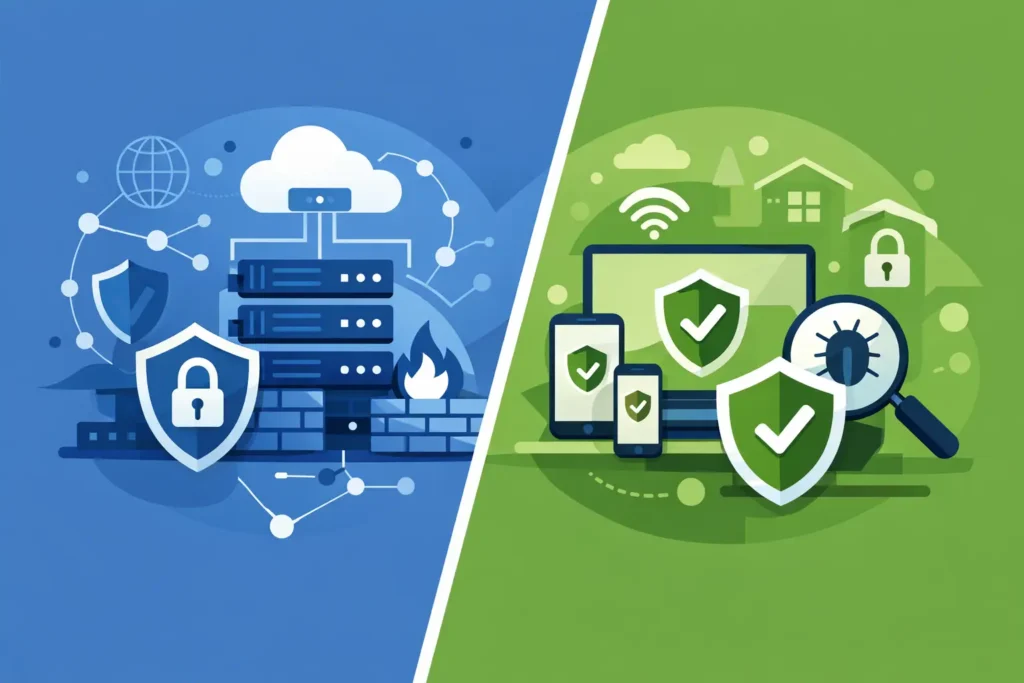
A business can have a well-configured firewall and still get hit by ransomware through a single employee laptop. It can also lock down every device and still leave room for lateral movement inside the network. That is the difference between network security and endpoint security in practical terms: one protects the environment traffic moves through, and the other protects the devices people actually use.
For business owners and IT decision-makers, this is not just a technical distinction. It affects how you budget, how you reduce downtime, and how well your security controls hold up when staff work across offices, warehouses, job sites, and remote locations. If you treat network security and endpoint security as interchangeable, you create gaps that attackers are quick to exploit.
What is the difference between network security and endpoint security?
Network security focuses on protecting the network itself. It monitors, controls, and filters traffic moving between users, devices, applications, and the internet. Typical controls include firewalls, intrusion prevention systems, VPNs, network segmentation, secure switching, and traffic monitoring tools.
Endpoint security focuses on protecting individual devices. These endpoints include laptops, desktops, servers, mobile devices, and sometimes specialized systems like point-of-sale terminals or shared office workstations. Endpoint security tools are designed to detect malware, block suspicious behavior, enforce device-level policies, manage patches, and respond when a device is compromised.
The simplest way to think about it is this: network security protects the roads, and endpoint security protects the vehicles using them. If the roads are controlled but the vehicles are infected, risk remains. If the vehicles are protected but the roads are wide open, risk remains there too.
Network security protects the business perimeter and internal traffic
For many organizations, network security is the first line of defense. It governs what is allowed into the environment, what can move between departments or systems, and what traffic should be blocked before it reaches critical assets.
This matters most in environments with shared infrastructure, on-premises servers, branch connectivity, wireless access points, IP telephony, CCTV systems, and a mix of managed and unmanaged devices. In those settings, the network is not just a connection layer. It is a business asset that needs policy, visibility, and control.
A properly designed network security model helps reduce exposure in several ways. Firewalls can inspect inbound and outbound traffic. VLANs and segmentation can separate finance systems from guest Wi-Fi or isolate surveillance networks from core business applications. Secure remote access controls can limit who connects and under what conditions. Monitoring tools can also flag unusual traffic patterns that suggest command-and-control activity or internal spread.
That said, network security has limits. It does not always see what is happening inside an encrypted endpoint session. It may not stop malware that arrives through a USB device or a malicious document opened locally. And if employees work from home or on the road, some activity may happen outside the corporate network entirely.
Endpoint security protects the devices users rely on every day
Endpoint security is centered on the reality of modern work: users click, download, install, connect, and move between environments. Every one of those actions creates potential exposure.
An endpoint security platform helps protect the device itself regardless of where it is being used. If a staff member is working from a branch office, home network, hotel Wi-Fi, or customer site, the endpoint still needs local protection. That includes anti-malware, behavioral detection, application control, encryption, patching, device compliance checks, and sometimes endpoint detection and response capabilities.
This approach is especially valuable because many attacks now begin at the user level. Phishing emails, infected attachments, browser-based exploits, and credential theft usually target the endpoint first. Once the attacker gets a foothold on a laptop or desktop, they often attempt privilege escalation, data exfiltration, or movement to other systems.
Endpoint security can contain that risk earlier. It can quarantine files, isolate infected devices, stop suspicious processes, and provide forensic visibility into what happened. For businesses without a large internal security team, that visibility can make the difference between a contained incident and a costly outage.
Still, endpoint security is not a complete answer by itself. If the network allows overly broad access, a compromised endpoint may still reach sensitive systems. If there is no segmentation, one infected machine can affect a much larger part of the business.
The real difference between network security and endpoint security is scope
When clients ask about the difference between network security and endpoint security, the most useful answer is scope.
Network security looks at how systems connect and communicate. It is concerned with traffic flow, access paths, trust boundaries, and network-based threats. Endpoint security looks at the health, behavior, and protection of each device that touches business data.
That difference in scope also shapes how each solution is deployed and managed. Network security is usually more centralized. Controls are placed at gateways, switches, wireless infrastructure, or data center edges. Endpoint security is distributed by design. It lives on each managed device and follows that device wherever it goes.
For a growing business, this distinction matters because your risk profile is rarely confined to one office. A company might have secure switching and firewall policies at headquarters but still have weak laptop hygiene, outdated field devices, or unmanaged contractor access. In that case, the network may be strong while the endpoints remain vulnerable. The opposite can also happen in cloud-first businesses that secure laptops well but neglect segmentation, VPN policy, or internal traffic visibility.
Where businesses get it wrong
A common mistake is assuming a firewall is enough. Firewalls are essential, but they do not replace endpoint protection. If a user opens a malicious file, the threat has already arrived at the device level.
Another mistake is overcorrecting in the other direction. Some organizations invest heavily in endpoint agents but ignore network design. Flat networks, weak Wi-Fi controls, and poor separation between systems increase the blast radius of any compromise.
There is also a budgeting issue. Businesses sometimes view security spending as a series of disconnected products rather than a coordinated architecture. That often leads to overlapping tools in one area and missing controls in another. The better approach is to align investments to actual business operations: how staff work, where data lives, what systems are mission-critical, and how fast the organization needs to recover from disruption.
Which one matters more?
It depends on the environment, but for most businesses, this is the wrong question. Network security and endpoint security solve different problems, and the stronger your operations become, the more obvious it is that both are necessary.
If your business runs from a central office with servers, shared storage, IP cameras, VoIP, and structured internal access rules, network security has a major role in preserving stability and control. If your workforce is mobile, remote, or heavily device-dependent, endpoint security becomes equally critical because the threat surface extends beyond the office.
In practice, the right priority is usually based on current gaps. If there is no business-grade firewall, no segmentation, and limited visibility into traffic, network security needs immediate attention. If devices are unmanaged, unpatched, or lack advanced threat protection, endpoint security should move to the front of the line. Mature environments address both together.
Why the best security strategy combines both
The strongest security posture comes from layering controls so that one weakness does not become a business-wide incident. Network controls help prevent unauthorized access and limit internal spread. Endpoint controls help stop compromise at the device level and speed up response when something gets through.
This layered model also supports better business continuity. If an endpoint is isolated quickly, operations may continue with minimal disruption. If the network is segmented properly, critical systems like servers, telephony, storage, or surveillance infrastructure are less likely to be affected by a problem elsewhere.
For companies that want accountability, this is where working with an experienced technology partner matters. Security is not just about installing products. It is about designing the right combination of network architecture, endpoint controls, monitoring, maintenance, and support around how the business actually operates.
The useful question is not whether network security or endpoint security is better. It is whether your current environment leaves either one underprotected. The answer usually shows up in the places businesses depend on most: uptime, user access, remote work, shared systems, and recovery speed when something goes wrong. If those areas matter to your operation, both sides of security deserve attention before the next incident makes the decision for you.